Reviewed by Josh N · Updated March 10, 2026 · How we verify
Introduction: Why Paranormal Mimics Feel More Terrifying Than Ghosts
Ghost stories have always held a powerful grip on the imagination. Shadowy figures in hallways, unexplained footsteps at night, cold spots in empty rooms, and whispers from unseen places all tap into a fear of the unknown. But among the many supernatural ideas that circulate in folklore and modern paranormal culture, few are as deeply unsettling as the idea of a paranormal mimic.
A mimic is not frightening simply because it may be supernatural. It is frightening because it imitates something that should be safe. It copies a familiar voice. It appears to be someone you know. It gives the impression that a loved one has entered the room, called your name, or moved through the house, only for you to discover that no one is there. That twist makes mimic stories especially disturbing. They do not just suggest that something paranormal may exist. They suggest that the familiar itself can become untrustworthy.
That is why stories about mimics have become so popular in modern horror and supernatural discussions. People are naturally disturbed by the idea of deception, especially when that deception involves family, home, memory, and trust. In many alleged encounters, the witness does not immediately realize something is wrong. For a brief moment, the voice or presence feels real. Then the truth settles in. The person they heard was asleep, not home, or standing somewhere else entirely.
Unlike more traditional ghost stories, mimic encounters often feel personal. They target the most intimate parts of a person’s life. A strange shadow in an old building is unsettling. A voice that sounds exactly like your spouse calling from the next room is something else entirely.
This is one reason mimics have become such a compelling topic for readers interested in hauntings, unexplained experiences, supernatural folklore, and the psychology of fear. The phenomenon sits at the crossroads of ancient legend, modern paranormal testimony, and the very human tendency to see patterns, hear meaning in ambiguity, and fear what feels almost real.
What Is a Mimic?
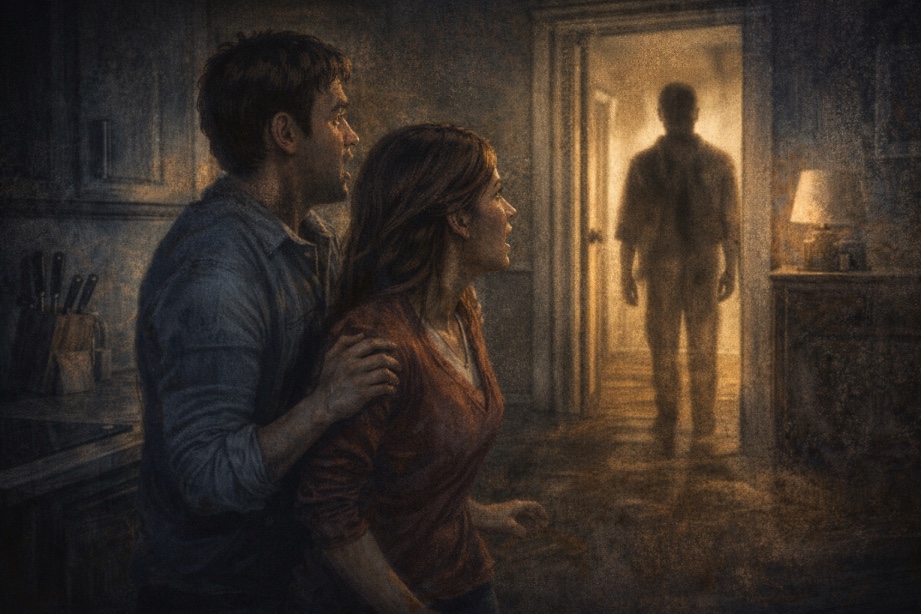
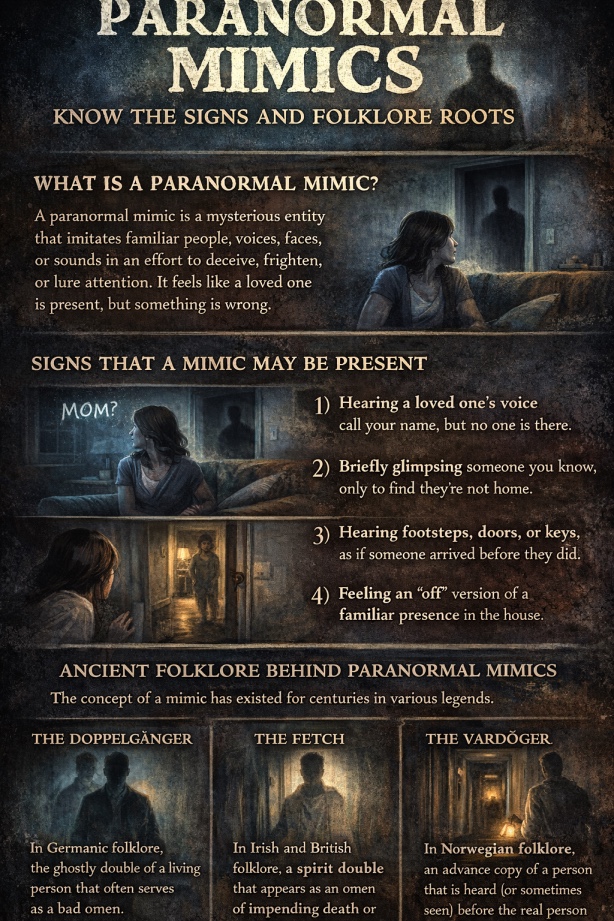
A paranormal mimic is generally described as an entity, spirit, or unexplained presence that imitates a person, voice, sound, movement, or emotional presence in order to appear familiar. The imitation may be visual, auditory, or atmospheric. In many reports, witnesses say they heard a loved one call their name, saw someone standing in a doorway who should not have been there, or sensed that a family member had just entered the house before realizing that person was nowhere nearby.
The term itself is largely modern. Unlike legendary creatures that appear in old folklore under one consistent name, the paranormal mimic is more of an umbrella category. It is used today to group together many kinds of uncanny experiences involving imitation, duplication, and deceptive familiarity.
Some people describe mimics as ghosts that have learned to copy household members. Others believe mimics are darker entities that intentionally imitate people in order to confuse or frighten the living. Still others treat the term more broadly, applying it to any experience involving a false familiar presence. That flexibility has made the concept very popular online, but it also means there is no single accepted definition.
At its core, though, the idea remains remarkably consistent. A paranormal mimic is frightening because it borrows trust. It does not always arrive as a monster. It arrives as someone or something you recognize.
The History of Mimics in Folklore and Legend
Although the phrase “paranormal mimic” is modern, the fear behind it is ancient. Stories of doubles, false appearances, spirit copies, and mysterious presences that imitate living people are found in folklore from many cultures. These older traditions may not use the word mimic, but they reflect the same deep anxiety: the idea that something supernatural can copy the living, appear ahead of them, or move through the world wearing a familiar face.
Folklore has always been one of the ways people explain experiences that feel too strange to fit ordinary reality. Sounds in the night, visions of living people in impossible places, or the overwhelming feeling that someone is present when they are not have all found their way into legends passed down over generations.
These traditions matter because they show that mimic stories are not just an invention of internet horror culture. The language may be new, but the emotional structure is very old. Human beings have long told stories about doubles, warnings, apparitions, and deceptive entities that imitate what is known.
Doppelgängers, Fetches, and Vardøgers: Older Versions of the Mimic Myth
One of the clearest ancestors of the modern mimic is the doppelgänger, a term associated with German folklore and literature. A doppelgänger is usually described as a double or apparition of a living person. Traditionally, seeing one’s own double or encountering the duplicate of someone else was considered an ominous sign, often linked to death, misfortune, or spiritual disturbance.
Closely related is the idea of the fetch in Irish and British tradition. A fetch is also a supernatural double, often appearing as a sign of impending death or crisis. In these stories, the double is not merely a visual copy. It is meaningful. It signals that something is wrong, that reality has shifted, or that a boundary between worlds has become thin.
Then there is the Norwegian concept of the vardøger, which may be even closer to what many people now call a mimic. A vardøger is often described as a sort of advance presence. People may hear footsteps, voices, or other familiar signs of a person arriving before that person actually appears. This is especially relevant to modern mimic stories, where the most common reported experience is not a full visual apparition but a familiar sound in the wrong moment.
Taken together, these traditions show that modern mimic lore did not arise from nowhere. It is part of a long lineage of stories about supernatural duplication and false familiarity. The modern label simply gathers these themes under one broader term.
Signs of a Mimic in Your Home
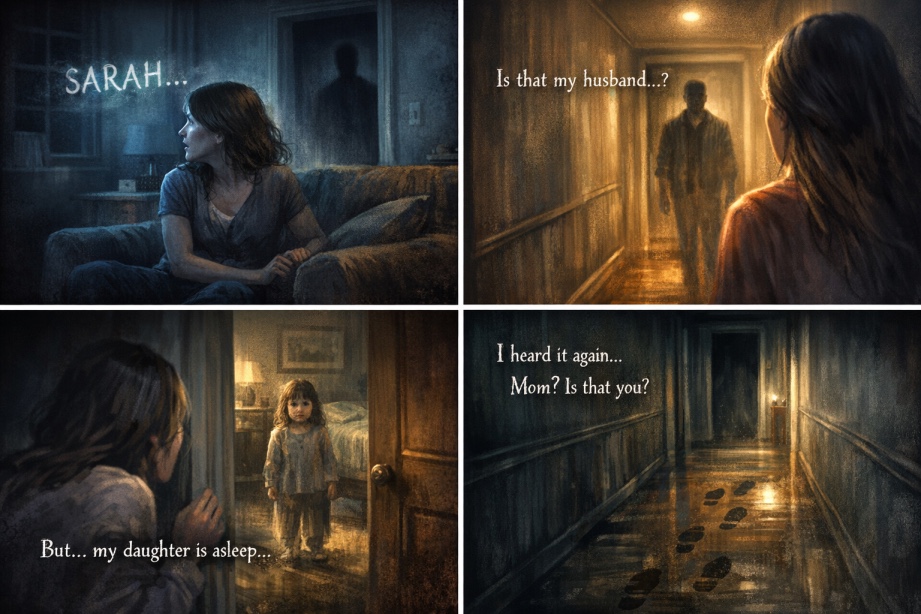
Many alleged mimic encounters follow similar patterns. The most commonly reported sign is hearing a loved one’s voice when no one is there. A parent may hear a child calling from upstairs, only to find the child asleep or not home. A person may hear their spouse say their name from another room, only to discover the spouse is outside, in the shower, or standing silently nearby.
Another common sign is the false visual impression of someone familiar. Witnesses sometimes report seeing a family member pass by a doorway, stand in a hallway, or move at the edge of vision. When they go to check, the person they thought they saw is elsewhere.
There are also reports involving sounds associated with a specific person: footsteps on the stairs, keys in the lock, a door opening, or the rustle of movement that seems identical to the arrival of someone known. This is one reason mimic stories are often set in homes. In domestic spaces, familiar sounds are part of everyday life. That makes a copied voice or copied arrival feel especially believable.
Some people also describe a subtler sign: the sense that something is wrong even when the imitation seems accurate. They say the voice sounded right but emotionally flat. The figure looked correct but moved strangely. The atmosphere felt off in a way that was hard to explain. That “almost right” quality is what makes the experience so disturbing. The fear comes from the small details that do not fit.
Can a Paranormal Entity Mimic a Loved One’s Voice?
This is one of the most common questions surrounding paranormal mimics, and it is central to why these stories are so haunting. In witness accounts, the voice imitation is often more frightening than a visual sighting. People trust voices. They respond to them automatically. A loved one calling your name from another room is one of the most normal sounds in everyday life. That is precisely why it becomes so effective in supernatural storytelling.
In many modern paranormal accounts, people describe hearing their mother, child, partner, or friend speak in a way that feels unmistakable at first. The terror comes seconds later, when they realize no one should have been there. Sometimes the voice only says a single word. Sometimes it calls their name. Sometimes it repeats a familiar phrase. Because the imitation is so personal, the experience can linger in memory for years.
From a paranormal perspective, believers argue that this kind of imitation may be a tactic. If an entity wants attention, emotional energy, or a reaction, copying a trusted voice would be one of the easiest ways to achieve it. From a skeptical perspective, the same experience may be interpreted as auditory misperception, stress, sleep-related hallucination, or grief-related perception. Either way, the emotional effect is the same. Hearing someone you know when they are not there feels profoundly wrong.
Paranormal Mimic vs Ghost: What Is the Difference?
The difference between a paranormal mimic and a traditional ghost lies mostly in behavior and emotional effect.
A typical ghost story centers on the presence of the dead. The ghost may appear as an apparition, create noises, move objects, or leave behind cold spots and strange feelings. The fear usually comes from the fact that something supernatural is present.
A mimic story, by contrast, centers on imitation. The fear is not just that something is there. It is that the thing present appears to be someone else. A mimic does not necessarily reveal itself as obviously supernatural at first. Instead, it tries to blend into the familiar. It borrows a voice, a shape, a movement, or a sense of presence that belongs to another person.
This makes the emotional tone of mimic stories different from ordinary hauntings. Ghost stories often generate dread. Mimic stories generate doubt. They make people question their senses, their homes, and the people around them. That uncertainty often lingers longer than a simple unexplained noise or shadow sighting.
Of course, some people believe mimics are simply a type of ghost behavior rather than a separate category. Others believe they are something more deceptive and potentially more dangerous. The lack of consensus is part of what keeps the topic so compelling.
Are Paranormal Mimics Real or Psychological?
This is where the subject becomes especially interesting, because mimic experiences sit at the edge of folklore, perception, belief, and psychology.
From a paranormal point of view, many people insist mimic encounters are real supernatural events. They point to the precision of the imitation, the repetition of similar stories across households and cultures, and the sense that the encounter carried an intelligence behind it. To believers, a mimic is not just a trick of the mind. It is a deliberate presence trying to imitate the living.
From a non-paranormal perspective, however, there are several possible explanations for at least some experiences. Stress, fatigue, grief, isolation, sleep disruption, and anxiety can all affect how people interpret sounds and sensations. Auditory misperception is common, especially in quiet or emotionally charged settings. A creak in a house, a distant television, wind, plumbing, or outdoor noise can sometimes be interpreted as a voice when the brain is primed to hear one.
Sleep-related experiences may also play a role. People waking from sleep or drifting into it can experience vivid sounds, voices, and perceptions that feel completely real in the moment. Grief is another important factor. Many bereaved people report hearing, sensing, or briefly seeing loved ones after death. These experiences can feel supernatural even when they may have roots in the psychology of mourning and attachment.
The existence of psychological explanations does not erase the power of mimic stories. In fact, it may deepen it. The reason these stories are so enduring is that they exist in a space where both interpretations feel possible. They are supernatural enough to terrify and human enough to be believable.
Why Paranormal Mimic Encounters Feel So Real
One reason mimic encounters linger in memory is that they often involve ordinary settings and believable moments. A haunted castle or abandoned asylum is already framed as eerie. A family home is not. That contrast matters.
When a person hears a loved one’s voice in their own house, the brain does not initially react with skepticism. It reacts with recognition. It accepts the sound because it fits a familiar pattern. Only afterward does the contradiction emerge. That delay creates a unique kind of fear. The witness is not startled by something obviously impossible. They are unsettled by something that became impossible only after it had already been accepted as real.
Mimic stories also feel real because they are usually small in scale. They do not rely on spectacular paranormal displays. They depend on a few seconds of uncertainty, a voice from the wrong room, a person glimpsed where they should not be, or the unmistakable sense that someone has entered the house before anyone actually has. Those moments are subtle enough to sound plausible and strange enough to be unforgettable.
This balance between normality and impossibility is what makes paranormal mimics such effective subjects for blogs, podcasts, horror stories, and firsthand witness narratives. They feel like the kind of thing that could happen to anyone.
How Social Media and Horror Stories Made Mimics More Popular
The internet has had a huge impact on how people talk about mimic experiences. In older times, a person might have interpreted a strange voice or false appearance using local folklore, family stories, or religious beliefs. Today, people go online and search for explanations. That means many very different experiences get pulled into the same broad paranormal category.
Social media, horror forums, podcasts, YouTube videos, and paranormal communities have helped popularize the term “mimic” as a catch-all label for anything that imitates a human voice or presence. The result is that a wide range of stories now get grouped together under one name. Some may resemble old doppelgänger legends. Some may echo ghost lore. Some may be sleep-related experiences. Some may be internet-enhanced horror storytelling. But once the label exists, it gives people a ready-made framework for understanding what happened.
This is how folklore evolves. Stories are not fixed. They absorb new media, new language, and new anxieties. The modern mimic is a perfect example of that process. It feels ancient because its core fear is ancient, but it also feels contemporary because the internet has turned it into a recognizable paranormal category.
Why the Idea of a Mimic Is So Deeply Unsettling
The real horror of a mimic is not violence. It is betrayal.
Human beings are wired to trust familiar voices, familiar footsteps, familiar faces, and the rhythms of everyday life. A mimic disturbs those foundations. It suggests that the things we rely on to orient ourselves in the world can be copied. It makes people question what they hear, what they see, and what they instinctively accept as safe.
That fear runs deeper than the fear of a random ghost or monster because it touches identity and intimacy. A mimic does not just enter the house. It enters the emotional structure of the house. It uses memory against the witness. It turns affection into uncertainty and routine into dread.
This is also why mimic stories tend to stay with people. Even if no further strange activity occurs, the witness may spend weeks or years replaying the moment in their mind. Was it really a voice? Was it exhaustion? Was something trying to get their attention? The uncertainty becomes part of the haunting.
In that sense, the paranormal mimic is one of the purest forms of supernatural fear. It does not need elaborate mythology to be effective. It only needs one impossible moment in which the familiar becomes wrong.
Frequently Asked Questions About Paranormal Mimics
What is a paranormal mimic?
A paranormal mimic is generally described as an entity or unexplained supernatural presence that imitates a familiar person, voice, sound, or appearance. In many reports, mimics are said to copy loved ones in order to confuse, frighten, or lure attention.
Are paranormal mimics the same as doppelgängers?
Not exactly. A doppelgänger is usually understood as a double or apparition of a living person, often linked to folklore and omens. A paranormal mimic is a broader modern term that can include copied voices, false presences, and deceptive appearances, not just visual doubles.
Can a paranormal mimic copy voices?
According to many paranormal witness accounts, yes. One of the most commonly reported mimic experiences involves hearing a loved one call your name, speak from another room, or make familiar sounds when that person is not actually there.
Are paranormal mimics ghosts or demons?
There is no universal answer. Some people believe mimics are a form of ghostly haunting, while others think they are deceptive entities or demonic presences. The interpretation usually depends on personal beliefs, religious views, and the context of the experience.
What are the signs of a paranormal mimic?
Common signs include hearing a loved one’s voice when no one is there, seeing someone who turns out not to be home, hearing familiar footsteps or arrival sounds at the wrong time, and sensing that something is imitating a person you know but feels emotionally off.
Are paranormal mimic experiences psychological?
Some may be. Stress, exhaustion, grief, sleep-related hallucinations, and auditory misperception can all contribute to experiences that feel very real and very unsettling. That does not make the experience meaningless, but it does provide a possible non-paranormal explanation for some reports.
Are paranormal mimics based on old folklore?
The exact term is modern, but the idea has deep roots. Folklore from several cultures includes doubles, apparitions, spirit copies, and false arrivals that strongly resemble what people now call mimic encounters.
Why are paranormal mimic stories so scary?
They are scary because they imitate what feels safe and known. A random shadow is frightening, but a voice that sounds exactly like your loved one is much more disturbing because it undermines trust in your own senses and surroundings.
Final Thoughts on Paranormal Mimics and the Fear of the Familiar
Paranormal mimics remain one of the most chilling ideas in supernatural culture because they blur the boundary between recognition and fear. They do not always appear as obviously monstrous. They come disguised as something familiar. A voice in the hallway. A figure in the doorway. The unmistakable sense that someone has just come home when no one has.
That is what makes them so effective in folklore, horror, and firsthand accounts alike. They do not rely on spectacle. They rely on intimacy. They take the ordinary structure of daily life and twist it just enough to make it feel unsafe.
Whether you interpret mimic encounters as paranormal events, modern folklore, psychological experiences, or some combination of all three, their power is undeniable. They endure because they target one of the oldest and deepest human fears: not simply that something unknown is out there, but that the thing you trust most may not be what it seems.
And that may be the most terrifying possibility of all.
Sources
https://www.britannica.com/art/doppelganger
https://www.britannica.com/topic/folklore-academic-discipline
https://www.britannica.com/art/legend-literature
https://digitalcommons.usu.edu/usupress_pubs/18
https://my.clevelandclinic.org/health/symptoms/23233-auditory-hallucinations
https://my.clevelandclinic.org/health/articles/23234-hypnagogic-hallucinations
https://pmc.ncbi.nlm.nih.gov/articles/PMC8388006
https://pmc.ncbi.nlm.nih.gov/articles/PMC7707065
https://my.clevelandclinic.org/health/diseases/capgras-syndrome
https://pmc.ncbi.nlm.nih.gov/articles/PMC9473424
Reader sightings
Nobody has reported anything here yet. If you have been, you would be the first.


Leave a Reply