
Reviewed by Josh N · Updated July 31, 2026 · How we verify
Reported Phenomena
- Reported apparitions
- Unexplained sounds
- Disembodied footsteps
- Voices with no source
Reported by visitors & local legend. Stories, not verified claims.
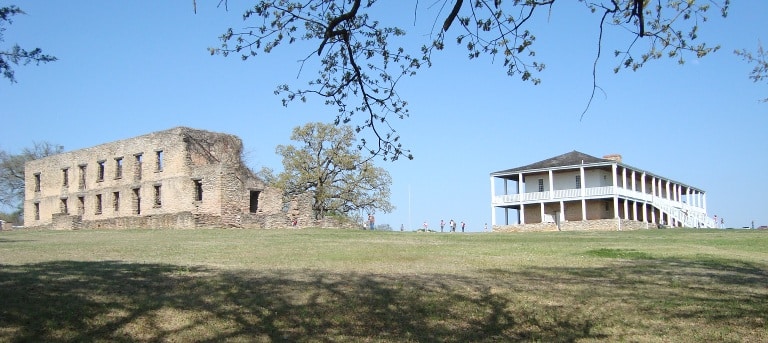
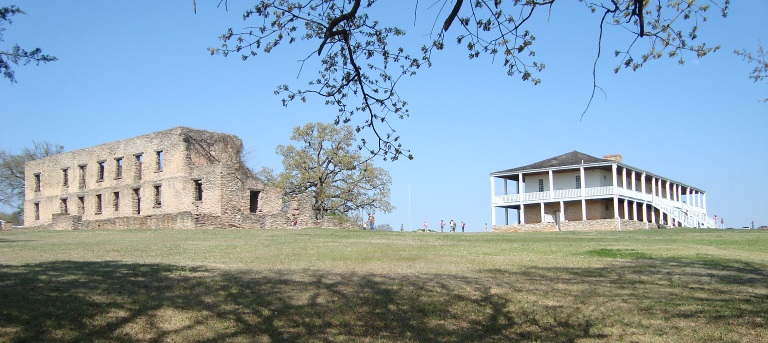
Twelve miles of prairie separate the town of Durant, Oklahoma from the limestone shells of Fort Washita, a frontier post that the United States Army built to guard one displaced nation from another, lost to the Confederacy in the first week of the Civil War, and never took back. What stands there now is a mix of ruin, reconstruction and burned-out reconstruction, held by the Chickasaw Nation and open to visitors. It is also one of the more persistently ghost-storied places in southern Oklahoma, though the documented history and the tales told about the grounds are two separate things, and it is worth keeping them apart.
Fort Washita at a Glance
- Where: about 12 miles northwest of Durant, on Oklahoma State Highway 199, just north of where the Washita River meets the Red River.
- Established: 1842, on a site chosen by General Zachary Taylor, later president.
- Original size: an expanse of more than seven square miles containing far more than ninety buildings and sites.
- Status: declared a National Historic Landmark in 1965; purchased by the Chickasaw Nation from the Oklahoma Historical Society in 2017; placed into federal trust in August 2023.
- Today: a historic site and museum hosting Civil War reenactments and an annual Fur Trade Rendezvous.
Why the Army Put a Fort Above the Washita River
The fort exists because of the Indian Removal Act, signed into law on May 26, 1830. The Choctaws were the first nation removed, ceding their lands in Mississippi and Alabama under the Treaty of Dancing Rabbit Creek in September of that year and traveling the Choctaw Trail of Tears to the southern part of Indian Territory along the Red River. The Chickasaws followed in 1837, paying the Choctaws $530,000 for the right to live on their lands.
The problem was geography. The Cross Timbers, a thick line of nearly impassable trees and brush, divided the dry plains to the west from the prairies where the removed nations were settling. Comanche, Wichita, Caddo and Kiowa people to the west occasionally raided the newcomers, and the Chickasaws proved reluctant to move into their assigned district because the nearest federal garrison, Fort Towson, sat too far east to protect them. In 1838 William Armstrong, Superintendent of Indian Affairs for the Western Territory, asked the War Department for a post near the mouth of the Washita River.
Zachary Taylor, then commanding the Second Military Department, selected the ground in 1842: high land a mile and a half east of the Washita River and 18 miles north of its junction with the Red, which was at that time the border with the new Republic of Texas. Construction began that spring, mostly by Companies A and F of the Second Dragoons, starting with temporary log barracks. Supply was a constant difficulty. Materials came largely from the surrounding country, and as late as 1845 Fort Washita was the only frontier fort not reachable by steamboat.
It nearly did not survive its first year. In March 1843 Taylor learned the War Department was considering abandoning the post before it was fully occupied. He testified to the value of the location, the plans were approved, and the Army occupied Fort Washita on April 23, 1843.
Two Thousand Soldiers and a Village Called Rugglesville
The site earned its keep because everything moved through it. An ancient trail ran north and south past the fort, known in Indian Territory as the Texas Road and beyond the Red River as the old Preston Trail, and Fort Washita became a major junction on it. The Shawnee Cattle Trail later used the same route, and just before the Civil War the Butterfield Overland Stage crossed a short distance east of the fort.
When the Mexican-American War began in May 1846, the post became a staging point and its average garrison of about 150 men swelled to nearly 2,000. During those years it also housed the Choctaw and Chickasaw Indian Agencies. The Chickasaws met nearby at Boiling Springs in 1846 and again on October 13, 1848, adopting a constitution that created a government separate from the Choctaws.
Gold changed the traffic again. After 1848, emigrants bound for California favored the southern route to avoid snow and cholera, and Fort Washita became their gathering point: parties rendezvoused there, consolidated, elected officers and made final preparations before crossing the Red River into Texas. In 1850 General Arbuckle ordered a new post established farther west to help protect them, which became Fort Arbuckle.
The permanent buildings went up in this period. The south barracks was raised in limestone in 1849, replacing the log structure, and the west barracks followed in 1856, also of native limestone. By 1858 there was an east barracks, a hospital and surgeon’s quarters, all in native stone, with a corral and stables on the hillside to the southwest. Cavalry made up most of the garrison until the 1850s, when the fort served as a United States Army Field Artillery School. Major Daniel Ruggles, who served here from 1849 to 1851 and eventually commanded the post, was popular enough that the small settlement west of the fort was named Rugglesville after him. Braxton Bragg’s 2nd Artillery Regiment, famous from Buena Vista, was posted here after the Mexican-American War. Randolph B. Marcy, George McClellan, William G. Belknap and Theophilus H. Holmes all served at Fort Washita.
Death visited early and often, as it did at any frontier post. Bean Starr of the Starr gang died in the fort hospital in the autumn of 1844 after being wounded in a shootout on the Washita River 25 miles upstream. General Belknap, commanding at Fort Arbuckle, died on November 10, 1851, in an ambulance between Preston, Texas and Fort Washita, and was interred at the fort.
April 1861: Emory Runs, and the Confederates Move In
Federal troops still held the fort when Confederate guns opened on Fort Sumter on April 12, 1861. Colonel William Emory, anticipating war, had concentrated his men from Forts Arbuckle and Cobb at Fort Washita. News reached him on April 16 and he marched for Fort Leavenworth, Kansas, with 4,000 Texas militia one day behind him. Confederate forces took the post without a fight.
Both the Choctaw and Chickasaw Nations were allied with the Confederacy for the duration. Fort Washita saw no combat, but it was an important Confederate supply depot in Indian Territory and served as a military hospital. It became the headquarters of Brigadier General Douglas Cooper after the Battle of Honey Springs; Albert Pike commanded briefly before establishing Fort McCulloch a few miles east, and Stand Watie was also among its Confederate commanders. Near the end of the war the garrison burned the standing buildings and walked away. The post was not truly abandoned until 1865, and the United States military never came back.
A Confederate cemetery remains on the grounds. The United States military graves were exhumed and reinterred at Fort Gibson near Muskogee. Douglas Cooper stayed on at the ruined fort after the war and died there on April 29, 1879, buried in the old fort cemetery in an unmarked grave.
The Colbert Farm and the Slow Return of the Ruins
The War Department handed the grounds to the Department of the Interior on July 1, 1870. The Dawes Act of 1887 and the Atoka Agreement of 1897 broke up the communal lands of the Chickasaw Nation into individual allotments, and the parcel containing the fort went to the Colberts, a prominent Chickasaw family. Charles Colbert converted the east barracks into a house, the other buildings were absorbed into farm use, and the family used the old cemetery as their own. The west barracks served as the Colbert household until it burned down in 1917.
In 1927 Dr. William Brown Morrison, a history professor at what is now Southeastern Oklahoma State University, walked the site and wrote that the ruins, “while rapidly disintegrating and disappearing,” were still very extensive and very interesting to anyone inclined to study Oklahoma’s past. When the Oklahoma Historical Society surveyed the ground in the 1960s it counted 86 structures, 50 foundations and 2 buildings still standing.
Ward S. Merrick Sr. of Ardmore funded the Historical Society’s purchase from the Colbert family in 1962. William “Buck” Loper and his wife Lela were living in what is now the park headquarters, and the Colberts arranged for them to stay until their deaths around 1963; both are buried in the fort cemetery. The National Historic Landmark designation came in 1965, the state legislature appropriated $10,000 for restoration in 1967, and in 1971 the Historical Society excavated the site and rebuilt the south barracks. Fire took that reconstruction too: the rebuilt South Barracks was destroyed on September 26, 2010. Ownership passed to the Chickasaw Nation in 2017, and the site entered federal trust in August 2023.
What Visitors Say Happens on the Fort Washita Grounds
The historical record for Fort Washita is unusually detailed, and none of it documents a haunting. What exists instead is a body of reported experience, accumulated over decades of visitors, campers, reenactors and paranormal investigators walking the ruins after dark.
The reports are consistent in kind rather than in detail: apparitions glimpsed near the standing stonework and along the old building lines, figures that do not resolve into anyone present, and sounds with no visible source, described variously as footsteps, voices and noises that carry across open ground when nobody is there. People who tell these stories tend to attribute them either to soldiers who died at the post, or to the Native people displaced by the removals the fort was built to police. Neither attribution can be tested, and both say as much about how the site’s history sits in local memory as about anything measurable on the grounds.
It is worth being plain about this. Fort Washita has a hospital where men died, a Confederate cemetery, a general buried in an unmarked grave, and a hundred and eighty years of burning and rebuilding. That is an atmosphere, and atmosphere accounts for a great deal at night in open country. The stories are real as stories. Nothing in the documented history of the fort confirms them.
Visiting Fort Washita
The site operates as the Fort Washita Historic Site and Museum under the management of the Chickasaw Nation, roughly 12 miles northwest of Durant on State Highway 199. There is far more ground than building: the original post covered over seven square miles, and what you walk through is a landscape of foundations, restored and unrestored stonework, the reconstructed and later burned South Barracks site, and the cemetery.
Time a visit to one of the events if you want the place populated. Fort Washita hosts Civil War reenactments and a yearly Fur Trade Rendezvous, which fill the prairie with encampments and give the ruins a scale that is hard to picture on an empty weekday. Check current hours with the Chickasaw Nation before driving out, since management of the site has changed hands twice in the past decade.
See Fort Washita for Yourself
Sources
- Fort Washita
- Fort Washita
- Reports of the Secretary of War: With Reconnaissances of Routes from San Antonio to El Paso
- Senate Documents, Otherwise Publ. as Public Documents and Executive Documents: 14th Congress, 1st Session-48th Congress, 2nd Session and Special Session
- Early Trails Through Oklahoma
- Wikipedia: Fort Washita
Frequently Asked Questions
Where is Fort Washita located?
Fort Washita is located at 12 miles northwest of Durant on State Highway.
Can you visit Fort Washita?
Fort Washita is open to the public. Always follow posted rules and respect private property.
Reader sightings
Nobody has reported anything here yet. If you have been, you would be the first.
Report your own visit to Three Fires and a Confederate Cemetery: Fort Washita
How haunted is this place?
Be the first to rate
Leave a Reply