

Reviewed by Josh N · Updated October 10, 2026 · How we verify
Reported Phenomena
- Shadowy figures
- Disembodied voices
- Being pushed or struck
- Unexplained sounds underground
Reported by visitors & local legend. Stories, not verified claims.
Five freight trains a day still run through the haunted Hoosac Tunnel, a 4.75-mile bore driven straight through the Hoosac Range of western Massachusetts, and that single fact explains most of what a visitor needs to know about it. This is not a ruin, not a museum, and not a place you can walk into. It is live railroad, carved out between 1851 and 1875 at a cost of $21 million and, by the verified count, 135 lives. The men who survived it called it the Bloody Pit. The ghost stories came later, and they have never stopped.
Hoosac Tunnel at a Glance
- Length: 4.75 miles (7.64 km), running in a straight line from the east portal on the Deerfield River in the town of Florida to the west portal in the city of North Adams.
- Built: work began in 1851; the first train passed through on February 9, 1875.
- Cost: estimated at $2 million, finished at $21 million.
- Casualties: 195 workers killed or seriously injured, with 135 verified deaths.
- Status today: active freight line, owned since 2009 by Pan Am Southern and carrying roughly five trains a day as of 2023.
- Recognition: named a Historic Civil Engineering Landmark by the American Society of Civil Engineers in 1975.
The name itself is older than the railroad. “Hoosac” is an Algonquian word meaning “place of stones.”
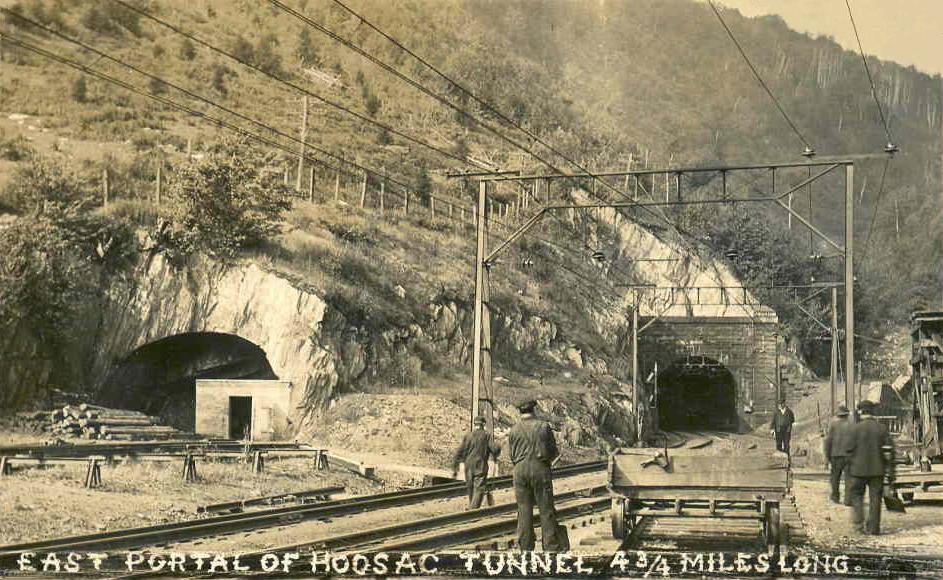
Twenty-Four Years of Digging Through Hoosac Mountain
The idea started as a canal. In 1819, promoters proposed linking Boston to Upstate New York by water, using the Deerfield River on the east side of the range and the Hoosic River on the west. That scheme was shelved and reborn as a railroad project, with Fitchburg paper mill owner Alvah Crocker as its most determined backer. Crocker secured a charter for the Troy and Greenfield Railroad in 1848, with provisions for a tunnel through the mountain, and work began in 1851.
Critics called it “The Great Bore.” Among them was the future Supreme Court Justice Oliver Wendell Holmes Jr., who remarked that he would like to “wall up a dozen lawyers at one end of the tunnel and put a good fee at the other.”
The job broke almost everyone who touched it. A tunnel boring machine, Wilson’s Patented Stone-Cutting Machine, was put to work on March 16, 1853, and failed after chewing through ten feet of rock. Crews went back to hand digging. Chief engineer Herman Haupt had excavated about 4,250 feet, roughly a fifth of the distance, when the rival Western Railroad successfully lobbied to block state funding in 1861. Haupt was bankrupted and left to serve as a Union Army railroad engineer and general in the Civil War. The Troy and Greenfield defaulted the following year and the Commonwealth of Massachusetts foreclosed and took the whole thing over.
What finally finished the tunnel was imported technique and raw persistence. The state sent engineer Charles Storrow to Europe to study nitroglycerin and compressed air. The project became the first large-scale commercial use of nitroglycerin and electric blasting caps, and the first such use anywhere in the United States. Workers bored a central shaft to open two more working faces, completing it in 1870, and a 1,000-foot elevator hoisted the spoil out. In all, two million tonnes of rock came out of the mountain.
The alignment held, which is the detail engineers still talk about. On December 12, 1872, the east portal heading met the tunnel dug outward from the central shaft, out of true by just nine-sixteenths of an inch. The west side was holed through on November 27, 1873. Bernard N. Farren took over as the final chief engineer on November 19, 1874, and on Thanksgiving Day that year the last sixteen feet of rock came down beneath North Adams.
The Bloody Pit: What the Casualty Record Actually Says
The round number of “nearly 200 dead” gets repeated constantly, and it is a blurring of two figures. Deadly accidents during construction killed or seriously injured 195 workers; of those, 135 deaths are verified. Men died in explosions, under falling rock, and in falls from ladders and scaffolding. Fourteen men died or were injured in 1866 alone. In 1865 the workforce went on strike and burned buildings in protest. The survivors named the place the Bloody Pit, and the name stuck to it for the next century and a half.
October 17, 1867: Fire in the Central Shaft
The single worst day happened 538 feet underground. Crews were sinking the tunnel’s 1,028-foot vertical exhaust shaft when a candle in the hoist building at the surface ignited naphtha fumes leaking from a gasometer lamp. The explosion set the hoist structure alight and it collapsed down the shaft. Four men near the top got out. Thirteen men working far below were trapped under burning naphtha and falling iron. The pumps were destroyed in the collapse, and water began filling the shaft.
The next day a worker named Mallory was lowered on a rope. He was overcome by fumes, reported no survivors, and no further rescue was attempted. Several months passed before crews reached the bottom. What they found there is the detail that has fed the tunnel’s reputation ever since: some of the victims had lived long enough to build a raft before suffocating.
Ringo Kelley and the Stories That Followed the Bodies Out
The best-known piece of Hoosac folklore concerns a worker named Ringo Kelly, said to have been implicated in the accidental deaths of two colleagues, who vanished and was later found dead at the exact spot of the earlier accident under unexplained circumstances. That account is passed down in local tradition and in the tunnel’s popular literature. It does not appear in the engineering and operational record of the project, and no documentary confirmation is offered for it here. Treat it as legend, which is what it is, and which does not make it any less durable: it is the story that supplied the tunnel with its revenge motive, the idea that the men killed in the bore stayed behind to settle accounts.
What People Report at the Portals
None of the following is verified, and most of it comes from visitors standing at or just inside the portal mouths rather than from anyone with sanctioned access to the bore. The recurring accounts are:
- Figures seen in the tunnel mouth or in the dark beyond it, with no workers or trains in the vicinity.
- Voices, cries and unexplained sounds inside the bore, often attributed to the construction dead.
- Physical contact: people describing being shoved or struck by something they could not see. These are among the more aggressive claims attached to the site, and they are also the hardest to assess.
- A rupture of a gas line within the tunnel, cited locally as one more entry in the Bloody Pit’s ledger of inexplicable events.
There is a plain alternative explanation worth holding alongside all of it. A 4.75-mile straight bore under a mountain, wet, pitch black, ventilated by a single fan running on low power because so few trains use the line, is an acoustic and sensory environment unlike anywhere else in New England. Sound travels oddly in it. Air moves in it. Neither fact disproves the stories, and neither should be ignored while telling them.
Seeing the Hoosac Tunnel Safely
The east portal in Florida and the west portal in North Adams can both be reached and viewed, and this is where responsible visiting begins and ends. The tunnel is an operational freight route owned by Pan Am Southern, converted to a single track in 1957, with trains still passing through daily. There are no pull-offs inside, no refuges along most of its length, and no way to outrun a train in a single-track bore. People have died in here for a hundred and seventy years, and not all of them during construction.
If you want context rather than a portal photograph, North Adams offers Western Gateway Heritage State Park, which interprets the railroad history of the area, and the surviving alignment towers built under chief engineer Thomas Doane after he took over in 1866 still stand on the mountain. Only four of the six remain, in ruins, and reaching them means old roads and a fair amount of bushwhacking through forest overgrowth. They are the quietest reminder on the site of just how hard it was to point a hole at something four and three-quarter miles away and hit it.
See The Hoosac Tunnel for Yourself
Sources
- Report of Benj. H. Latrobe, Consulting Engineer, on the Troy and Greenfield Railroad and Hoosac Tunnel
- Workers Complete Hoosac Tunnel
- The Hoosac Tunnel
- The World of Lore, Monstrous Creatures
- Partial wall collapse temporarily shutters Hoosac Tunnel
- Wikipedia: Hoosac Tunnel
Frequently Asked Questions
Can you visit The Hoosac Tunnel?
The Hoosac Tunnel is open to the public. Always follow posted rules and respect private property.
Reader sightings
Nobody has reported anything here yet. If you have been, you would be the first.
Report your own visit to Naphtha, Fire and a Raft: The Haunted Hoosac Tunnel
How haunted is this place?
Be the first to rate

Leave a Reply