

Reviewed by Josh N · Updated October 8, 2026 · How we verify
Reported Phenomena
- Phantom footsteps
- White figure on balcony
- Headless cook sighting
- Child apparition
- Bloodstained floorboards
- Apparitions near cemetery
Reported by visitors & local legend. Stories, not verified claims.
Randal McGavock named his Williamson County estate for his father’s birthplace in County Antrim, Ireland, and the Gaelic word behind the name, cairn, means a pile of stones, the kind sometimes heaped over a grave. He could not have known how literal that would turn out to be. Carnton Plantation, a short drive from downtown Franklin, Tennessee, became the largest temporary field hospital of the Battle of Franklin on November 30, 1864, and the floorboards still carry the stains. The documented history is unusually well preserved. The ghost stories are a separate matter: they come from visitors and staff, they are anecdotal, and none of them has ever been verified.
Quick Facts on Carnton
- Built: 1826, by Randal McGavock, using enslaved labor, on a property of about 1,420 acres
- Style: red brick Federal, eleven rooms, with a Greek Revival portico added in 1847
- Battle: November 30, 1864, fought less than a mile from the house
- Dead at Franklin: more than 1,750 Confederates; Franklin residents were left to bury over 2,500 soldiers
- Cemetery: the McGavock Confederate Cemetery, the largest privately owned military cemetery in the United States
- Listed: National Register of Historic Places, 1973
- Managed by: The Battle of Franklin Trust, a non-profit that also runs the Carter House
The House Randal McGavock Built
Randal McGavock (1768 to 1843) came from Virginia and settled in Nashville, where he served a one-year term as mayor in 1824. He knew President James K. Polk and was a good friend of Andrew Jackson, who lived at The Hermitage nearby and stayed with the McGavocks more than once. A rocking chair Jackson gave the family is still in the house, along with the working clock on the parlor mantel and a 200-piece china set in the dining room.
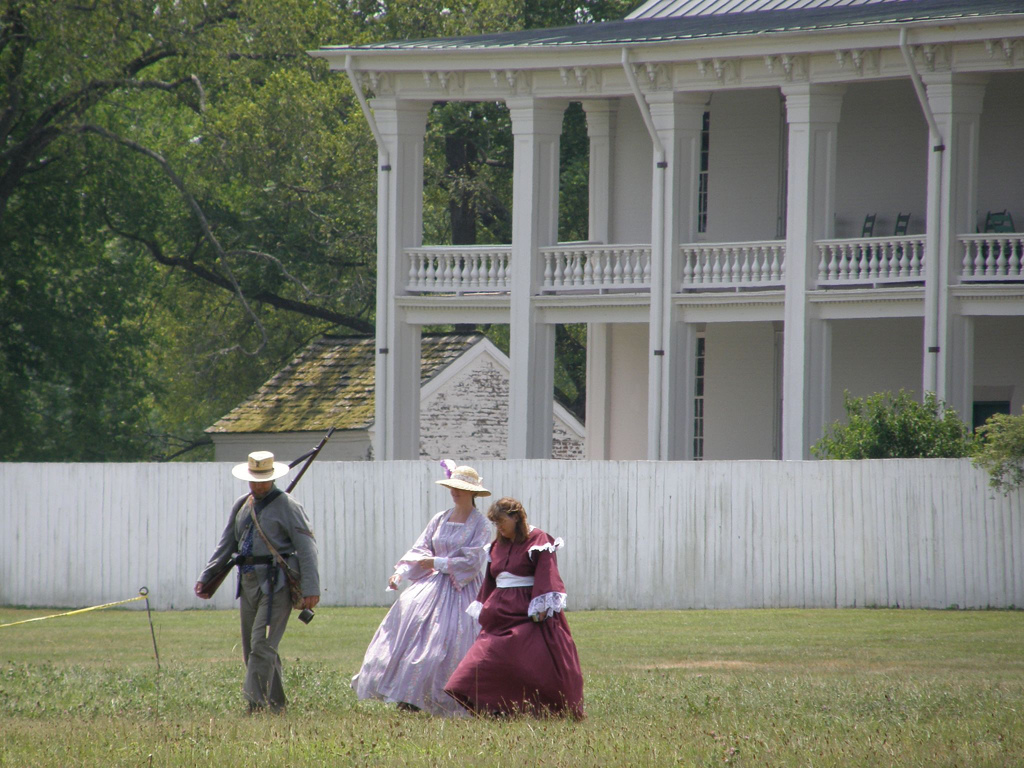
The first building on the site was a smokehouse, put up in 1815 and later joined to the main house by a two-story kitchen wing. The mansion itself was completed in 1826: a five-bay, two-story block on a raised limestone foundation, with a tin gabled roof, dormers and end chimneys. Of the roughly 1,400 acres, about 500 were farmed, in wheat, corn, oats, hay and potatoes, and the McGavocks also bred livestock and thoroughbred horses. Randal’s daughter Elizabeth married William Giles Harding of Belle Meade Plantation, which became an internationally known thoroughbred farm.
Randal died in 1843 and left Carnton to his son John (1815 to 1893). In December 1848 John married his cousin Carrie Winder (1829 to 1905) of Ducros Plantation in Thibodaux, Louisiana. She brought with her an enslaved woman, Mariah Reddick. The couple remodeled in the fashionable Greek Revival taste, adding the two-story pedimented portico with its four square Ionic columns, new wallpapers, faux painting and carpets. John also laid out a one-acre garden west of the house, following the writings of Andrew Jackson Downing, with vegetable squares inside ornamental borders and a picket fence to keep the animals out. Just before the war, John McGavock’s net worth stood at roughly $339,000 in 1860 dollars. The couple had five children; only two lived to adulthood.
November 30, 1864: The Largest Field Hospital at Franklin
John McGavock was 46 when the Civil War began, too old to enlist, so he helped outfit and organize Southern units while Carrie sewed uniforms for relatives and friends. As Federal troops took Middle Tennessee and learned what the family had been doing, they stripped thousands of dollars’ worth of grain, horses, cattle and timber from the plantation. John had already sent most of the enslaved people at Carnton to Louisiana to keep them out of Federal hands.
The battle came to the McGavocks on November 30, 1864. Carnton sat less than a mile from the fighting on the far Union eastern flank, and the house became the largest temporary field hospital of the engagement. As many as 300 wounded men were brought inside. At least 150 of them died the first night. Hundreds more lay across the rest of the property, including in the slave cabins. Carrie McGavock gave up food, clothing and supplies to care for them, and witnesses described the hem of her dress soaked with blood. Her children Hattie, then nine, and Winder, then seven, saw all of it and helped the surgeons where they could.
The floors are stained to this day. The heaviest staining is in one of the southern-facing bedrooms used as an operating room, where blood soaked through the carpets and into the wood beneath.
On the back porch, four dead Confederate generals were laid out for a few hours after the fighting stopped: Patrick Cleburne, John Adams, Otho F. Strahl and Hiram B. Granbury. More than 1,750 Confederates lost their lives at Franklin. The following day, December 1, Union forces under Major General John M. Schofield pulled back toward Nashville, leaving behind their dead, several hundred of them, and the wounded who could not walk. The people of Franklin were left to bury over 2,500 men.
The McGavock Confederate Cemetery and the Widow of the South
The first burials were improvised. According to George Cowan’s history of the cemetery, the Confederate dead were buried by state as far as possible, close to where they fell, with wooden headboards marking name, company and regiment. Within eighteen months those boards were rotting, being taken for firewood, or had simply weathered blank.
John and Carrie McGavock donated two acres of their land so the dead could be moved somewhere permanent. The citizens of Franklin raised the money, and in the spring of 1866 a team led by George Cuppett reinterred 1,481 soldiers at a cost of $5.00 per man, along with one civilian: Marcellus Cuppett, George’s brother, who died during the work. Cuppett recorded every name and identity in a cemetery record book, which passed afterward into Carrie McGavock’s keeping. Most of the Union dead had already been moved in 1865 to the Stones River National Cemetery in Murfreesboro.
The result is the largest privately owned military cemetery in the country, arranged by state into thirteen sections divided by a fourteen-foot pathway, and still maintained by the Franklin Chapter of the United Daughters of the Confederacy. Carrie McGavock looked after it with African American workers for 41 years, until her death in 1905. A prayer printed in Confederate Veteran that year called her “the Good Samaritan of Williamson County.” Her life became the subject of Robert Hicks’s 2005 novel The Widow of the South, a New York Times bestseller, and that book is why a good share of Carnton’s visitors come at all.
From Sharecropping to Ruin and Back
John McGavock kept farming Carnton under sharecropping arrangements with formerly enslaved people until his death in 1893. His son Winder inherited the house when Carrie died in 1905 but lived only two more years, dying in 1907. His widow and children moved into Franklin. In 1909 a tornado tore off the eastern kitchen wing; the roofline where it met the mansion is still visible on the brick. She sold the property in 1911, ending a century of family ownership.
Carnton then passed through several hands and was in poor condition by the late 1960s and 1970s. The Carnton Association formed in 1977 to buy and restore it, and the following year Dr. and Mrs. W. D. Sugg, owners since the 1950s, gave the house and ten acres to the association. Another 38 acres were acquired later, and restoration of house and grounds was finished by the late 1990s. The garden, neglected for most of the twentieth century, was recreated in 1996 and 1997 to its 1869 appearance using archaeology, photographs and letters. Its daffodils, hostas and peonies are all varieties available in Middle Tennessee before 1869, and Carnton is believed to hold the largest historic daffodil collection in the South, around 40 pre-1869 varieties.
The house was listed on the National Register of Historic Places in 1973 and has never received local, state or federal funding.
What People Say They Have Seen at Carnton
Nothing in the documented record of Carnton involves a ghost. What follows is folklore and anecdote, reported by visitors and staff over the years, with no verification behind any of it. Readers should treat it as the stories people tell about the place rather than as events.
The most repeated account is of footsteps on the wooden floors with nobody walking on them, usually attributed to General Patrick Cleburne, whose body was among the four laid out on the back gallery. In the early 2000s a figure in white was reportedly seen on the second-story balcony, facing the direction of the cemetery. Other accounts describe apparitions said to be Native American, and the figure of a young girl, described in local retellings as having been murdered. There is also a long-running story of a headless cook near the kitchen area, which is worth noting alongside a fact from the record: the kitchen wing itself was destroyed by the 1909 tornado and no longer stands.
Visitors frequently describe the upstairs operating room as the heaviest part of the house, a reaction that is hard to separate from the stains on the floor and from knowing what happened in there. A building where at least 150 men died in a single night tends to produce strong impressions without requiring anything supernatural.
Visiting Carnton in Franklin
Carnton operates as a museum and educational site under The Battle of Franklin Trust, which also manages the Carter House elsewhere on the battlefield. The interior is seen on guided tours; interpretation focuses on the McGavock family, the enslaved people who built and worked the property, and the battle. The grounds include the recreated 1869 garden and the McGavock Confederate Cemetery, which is maintained by the United Daughters of the Confederacy and remains a burial ground, so visitors should behave accordingly.
Anyone making a trip of it can pair Carnton with the other listed sites in the Franklin battlefield area, among them Winstead Hill, the Fountain Carter House and Fort Granger. Check current hours and tour times with the Trust before traveling, since the site is privately funded and schedules change. Come for the ghost stories if you like, but the thing that stays with most people is the floor of the upstairs bedroom and the names in Cuppett’s book.
See Carnton Plantation for Yourself
Sources
- Carnton Plantation
- For Cause & for Country: A Study of the Affair at Spring Hill & the Battle of Franklin
- Robert Hicks, Blockbuster Author and Battlefield Savior, Dies at 71 (The New York Times)
- Carnton Plantation
- In the Garden: Digging History
- Wikipedia: Carnton
Frequently Asked Questions
Can you visit Carnton Plantation?
Carnton Plantation is accessible by guided tour only. Always follow posted rules and respect private property.
Reader sightings
Nobody has reported anything here yet. If you have been, you would be the first.
Report your own visit to Blood in the Floorboards: Carnton Plantation, Franklin
How haunted is this place?
Be the first to rate
Ghost Tours Nearby
 Franklin Haunted Pub Crawlfrom $35
 Ghost Tour of Downtown Franklin Haunting Stories and Historyfrom $30
 What Waits in the Dark Adults Only Tourfrom $35
Affiliate links: BeyondHaunted may earn a commission, at no extra cost to you.
Leave a Reply