
Reviewed by Josh N · Updated July 28, 2026 · How we verify
Reported Phenomena
- Red Lady apparition
- Residence hall ghost
Reported by visitors & local legend. Stories, not verified claims.
The Huntingdon College Red Lady is the single ghost story most often attached to this small Methodist campus in Montgomery, Alabama. According to the legend, she is the spirit of a female student from the early twentieth century who took her own life inside her room in Pratt Hall. That is the extent of what the record actually says. There is no verified account of the death, no documented name, and no proof of a haunting. What survives is a story that has been passed down on campus and repeated in Alabama folklore collections for decades.
Quick orientation: Huntingdon College is a private Methodist college in Montgomery, Alabama, chartered in 1854 as Tuskegee Female College and relocated to Montgomery in 1909. The campus is listed on the National Register of Historic Places as the Huntingdon College Campus Historic District. It is an active, working college, not an abandoned site or a ghost tour attraction.
History of Huntingdon College
The college was chartered on February 2, 1854, as Tuskegee Female College by the Alabama State Legislature and Governor John A. Winston. Its first president was Andrew Adgate Lipscomb, who built the institution as a teaching college rather than a research one.
In 1872 the name changed to Alabama Conference Female College when the school came under the auspices of the Methodist Episcopal Church, South. As the college and the region struggled to rebuild after the Civil War, leaders decided the institution needed a larger city, and they chose the state capital.
In 1908 they bought a 58 acre parcel on what was then the edge of Montgomery, now part of the Old Cloverdale neighborhood. The campus landscaping was designed by Frederick Law Olmsted Jr., whose other work included the Biltmore Estate and Central Park.
The Hamner Hall Fire
The move to Montgomery began with a disaster. On August 24, 1909, the college moved all of its furniture, laboratory chemicals, and records into Hamner Hall. The building burned to the ground that same night. The fire destroyed the records of the college’s first fifty years along with all of its furnishings.
Students and President William Martin spent that school year at Sullins College in Virginia while construction continued on the first permanent building in Montgomery, John Jefferson Flowers Memorial Hall. This is worth noting for anyone chasing the Red Lady story: the loss of five decades of institutional records in a single night is one practical reason why so little documentation exists for anything that happened in the college’s earliest era.
The Campus and Its Architecture
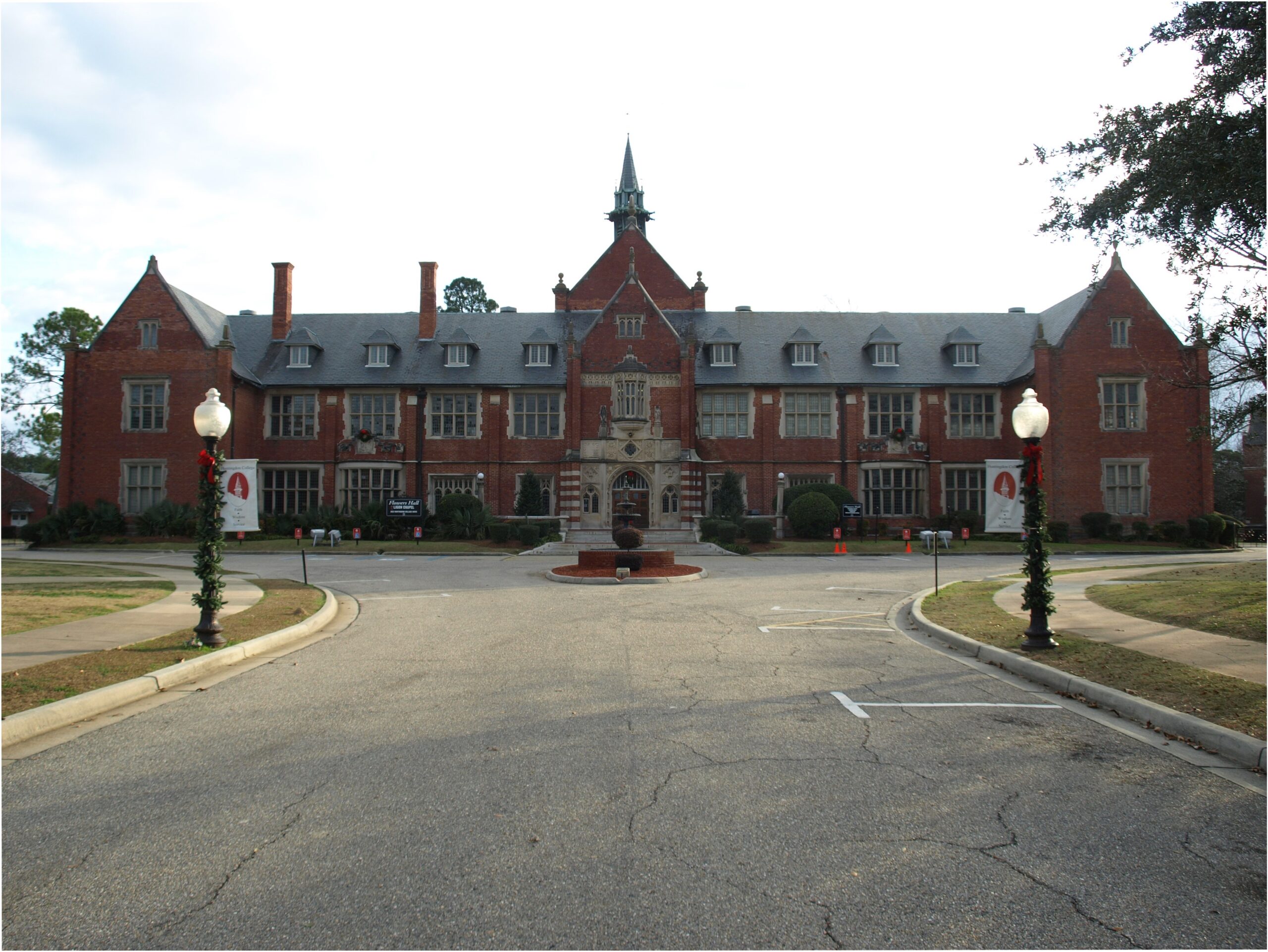
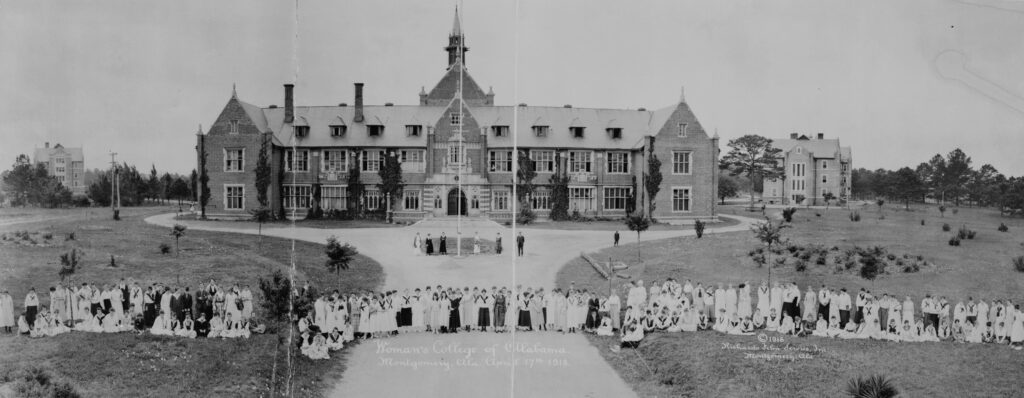
Flowers Hall was completed in 1910 and designed by Harvard architect H. Langford Warren to emulate the collegiate Gothic architecture of Oxford, Cambridge, and Harvard. It set the architectural tone for everything that followed. In 1910 the school was also renamed the Woman’s College of Alabama.
The Huntingdon College Campus Historic District was added to the National Register of Historic Places on February 24, 2000. It contains thirteen contributing buildings in the Gothic Revival and Tudor Revival styles, plus one site. The Gothic Revival stonework, the shadowed archways, and the age of the buildings do a great deal of work in keeping the campus ghost story alive.
From Woman’s College to Huntingdon
The college admitted its first male students after World War I and graduated its first male student in 1934. Recognizing that the old name no longer described the student body, the institution was renamed Huntingdon College in 1935 in honor of Selina, Countess of Huntingdon, a notable supporter of John Wesley and of Methodism.
Today Huntingdon offers more than 50 undergraduate programs and fields 18 NCAA Division III athletic teams. Enrollment grew 88 percent overall between 2002 and 2012, from 594 to 1118, and The Chronicle of Higher Education listed the college in 2014 among the fastest growing colleges in America. The college expanded across Fairview Avenue with the Cloverdale Campus in 2001.
The Red Lady of Pratt Hall
The Red Lady is the campus legend. She is said to be the ghost of a female student from the early twentieth century who died by suicide in her room in Pratt Hall. That is the whole of the documented claim, and it should be treated as folklore rather than history. No date, no name, and no contemporary account is attached to the story in the available record.
The Red Lady belongs to a broader tradition of Alabama ghost storytelling, and Huntingdon has an unusually direct link to it. Kathryn Tucker Windham, the writer whose 1969 book 13 Alabama Ghosts and Jeffrey shaped how the state tells its ghost stories, attended Huntingdon and is listed among its notable alumni. Alabama’s most famous ghost collector and its most famous campus ghost come from the same small college.
Reported Phenomena
The reported activity at Huntingdon is narrow and specific compared to most haunted sites. The tradition centers entirely on the appearance of the Red Lady, an apparition associated with a student residence hall on campus. Beyond that single figure, the source record does not describe footsteps, voices, object movement, or any of the other phenomena commonly reported at older institutional buildings.
None of this is verified. Nothing about the Red Lady has been confirmed by records, and the fire of 1909 means that the college’s earliest paperwork no longer exists to check against. What is real is the persistence of the story itself, retold on campus for generations.
Visiting Huntingdon College
Huntingdon College is an active private college in the Old Cloverdale neighborhood of Montgomery, Alabama, not a tourist site. Pratt Hall and other residence buildings are student housing and are not open to the public. There are no public ghost tours documented here, and no legal access for paranormal investigation.
What visitors can reasonably do is appreciate the campus itself from the standpoint of architecture and history. The Gothic Revival and Tudor Revival buildings of the National Register historic district, the Olmsted Jr. landscaping, and Flowers Hall are all part of the public face of the campus. Anyone planning a visit should contact the college directly about access, since a working campus sets its own rules on where outsiders may go.
Address: Montgomery, Alabama
Video
Sources
- Npgallery.nps.gov
- Webcitation.org
- Webcitation.org
- Npgallery.nps.gov
- Npgallery.nps.gov
- Wikipedia: Huntingdon College
Frequently Asked Questions
Where is Huntingdon College Red Lady located?
Huntingdon College Red Lady is located at Montgomery, Alabama.
Reader sightings
Nobody has reported anything here yet. If you have been, you would be the first.
Report your own visit to Huntingdon College Red Lady: The Pratt Hall Ghost Story
How haunted is this place?
Be the first to rate
Ghost Tours Nearby

Affiliate links: BeyondHaunted may earn a commission, at no extra cost to you.
Nearby Haunted Locations
- 1Eliza Lucas, the Federal Road, and Lucas Tavern GhostsAlabama0.4mi
- 2Hank Williams and the Haunted Redmont Hotel in BirminghamAlabama41mi
- 3The Outlaw and the DogAlabama41mi
- 4The Old Bibb County Jail Is Gone but the Stories RemainAlabama62mi
- 5Ghosts of the Gaines Ridge Dinner ClubAlabama62mi
- 6The Nursemaid in the CorridorAlabama76mi
Leave a Reply