

Reviewed by Josh N · Updated September 29, 2025 · How we verify
This article shares practical steps and documented history around “hauntings.” It’s informational only—not medical, legal, or professional advice. If you feel unsafe, or someone is at risk, contact local authorities.
TL;DR
Most “ghost” problems turn out to be fixable, earthly problems—drafts, wiring faults, infrasound, or carbon monoxide (CO)—and those can be dangerous. Start with safety checks (CO alarms, gas/electrical inspections). When the problem is psychosocial—stress, grief, conflict—lean on healthy routines and community support. If you want religious or spiritual help, work with reputable traditions that require medical and psychological screening first. Historical cases show activity often stops after moving, changing the environment, or following faith-based rites, but claims remain contested.
Table of Contents
- First, Make It Safe
- Rule Out Natural Causes That Feel “Supernatural”
- Practical Home Fixes That Quiet “Activity”
- Evidence-Based Stress & Sleep Resets
- When You Want Religious/Spiritual Help (and How it Works)
- Ethical Notes on Smudging & Cultural Practices
- What History Says: Cases People Cite as “Resolved”
- When to Seek Professional Help
- Quick FAQ
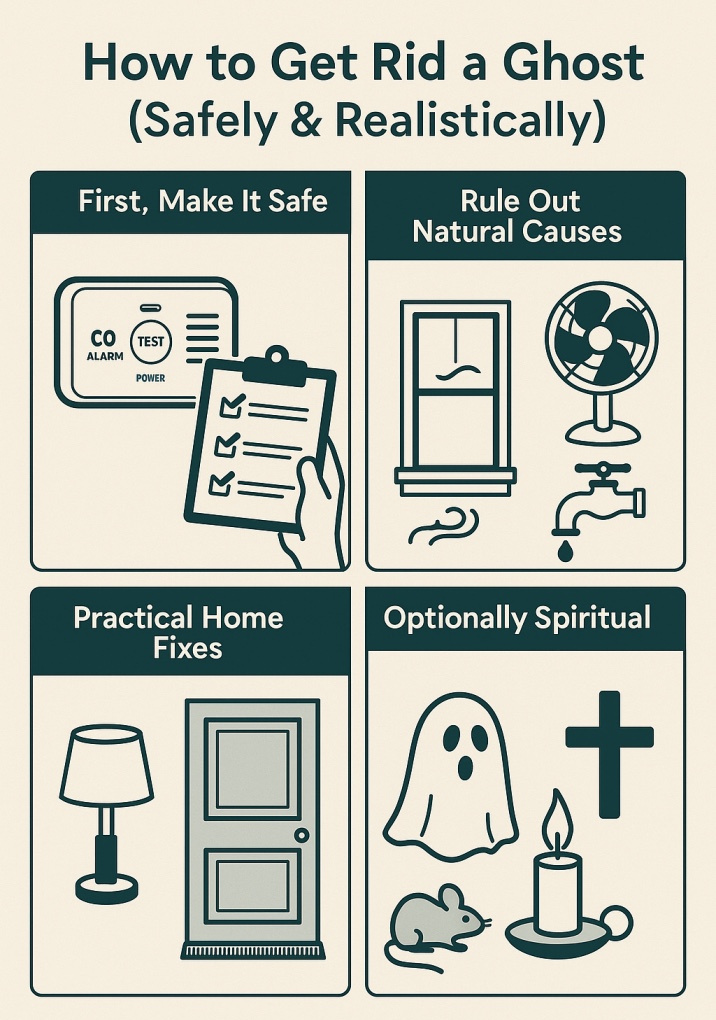
1) First, Make It Safe
Before you do anything mystical, do the life-safety basics:
- Install/test carbon-monoxide (CO) alarms on every level and near sleeping areas. CO is odorless and can cause headaches, nausea, confusion, fear, even hallucinations—sensations often misread as “haunting.” The CDC estimates 400+ accidental, non-fire CO deaths and 100k+ ER visits annually in the U.S.
- Have a licensed HVAC/gas tech inspect furnaces, water heaters, chimneys, and vents (especially after storms or renovations). Recent tragedies underscore the risk in homes lacking CO alarms.
- Electrical safety check. Faulty wiring, arcing outlets, and high-load circuits can cause flickers, buzzing, and smells that people label as “paranormal.”
- Mold & air quality. Hidden moisture can trigger headaches, breathing issues, and uneasy feelings.
Why this matters: If your “ghost” is an undetected CO leak or electrical fault, you don’t have a spirit—you have an emergency. Fixing it removes the “haunting” and the danger. (For historical context on CO being mistaken for hauntings, see documented cases and public-health reviews.
2) Rule Out Natural Causes That Feel “Supernatural”
- Infrasound (≈19 Hz) & vibration. Low-frequency sound from fans, HVAC, or large rooms can cause chest tightness, anxiety, chills, and even fleeting shadowy “peripheral” visuals. A classic paper showed a lab sword vibrating at 19 Hz while the researcher experienced a “haunted” sensation; fixing the fan stopped it.
- Drafts & pressure changes slam doors and make voices travel; old sash windows hiss and rattle at night.
- Plumbing & water hammer create knocks/footstep-like sounds through studs.
- Electrical/EMF worries. Everyday low-level electromagnetic fields from home wiring and Wi-Fi are not confirmed to cause the kinds of sensations often attributed to hauntings; major reviews find no adverse health effects from low-level, long-term RF/ELF exposure. Focus on fixing faulty wiring for safety—not on “EMF shields.”
What to do: Temporarily power down suspect fans/HVAC at night, log if the “activity” drops; add door sweeps, insulate rattling ducts, and bleed plumbing lines. Keep a written log of date/time, who observed what, and what was running in the house.
3) Practical Home Fixes That Quiet “Activity”
- Light & noise discipline. Replace flickering bulbs, use warm night-lights in hallways, place felt pads under furniture that “moves,” and add weatherstripping to doors/windows.
- Sound mapping. One quiet night, walk the house while a partner toggles HVAC, bathroom fans, and faucets. Note where ducts boom or pipes tick; pad/strap accordingly.
- Vermin & wildlife. Squirrels, raccoons, and mice create scratching, thumps, and whispers inside walls. Seal entry points; set humane traps or call pest control.
4) Evidence-Based Stress & Sleep Resets
Haunting reports spike with sleep deprivation, grief, and chronic stress—conditions that also intensify hypervigilance at night.
- Reset nights: fixed bedtime, 30–60 minutes of low-light wind-down, no caffeine after early afternoon.
- Daylight & movement: 20–30 minutes of morning light and a daily walk help regulate circadian rhythm.
- Talk it out: Family meetings reduce suggestion effects (“Did you hear that?!”). If anxiety persists, consider a clinician—especially if someone is experiencing frightening thoughts or visions.

5) If You Want Religious or Spiritual Help—Do It the Right Way
Many people feel better after house blessings, deliverance prayers, or similar rites within their tradition. Responsible ministries in major churches require medical/psychological evaluation first, precisely to rule out natural causes:
- Catholic guidelines (United States Conference of Catholic Bishops): official exorcism texts were implemented in U.S. dioceses in 2017; bishops authorize trained priests, and proper discernment includes thorough medical/psychological screening before any solemn rite.
- Church of England deliverance teams: clergy work in consultation with physicians and mental-health professionals, and obtain consent/safeguarding before formal rites.
If you seek this route, contact your local diocese or faith community (not random online “exorcists”). Ask about their screening protocol and collaboration with healthcare professionals.
6) A Note on Smudging, Sage, and Cultural Respect
Many people try smoke-cleansing (often called “smudging”) for peace of mind. Know that smudging is a sacred Indigenous ceremony in many Native/First Nations cultures (commonly involving tobacco, sage, cedar, and sweetgrass) and has faced over-harvesting and cultural appropriation concerns. If you choose a smoke-cleansing practice, consider learning the cultural background, seeking permission or guidance, and sourcing materials ethically; or use non-appropriative alternatives (saltwater at thresholds, gentle bell, open-window “reset,” prayer/meditation in your own tradition).
7) What History Says: Cases People Cite as “Resolved”
These are contested cases (skeptics and believers disagree), but they show common patterns in how situations “end.”
- Enfield (London, 1977–79). Famous “poltergeist” with raps, tossed objects, and voices. Activity reportedly tailed off by 1979 as the children grew older; investigators were split between genuine phenomena and pranks.
- Rosenheim (Germany, 1967). Office disturbances (lights, phones, pictures). Claims say activity ceased when the teenage secretary left and later married—a pattern often cited in poltergeist literature. Critics later suggested trickery with threads; the case remains disputed.
- Ammons (“200 Demons” house, Gary, Indiana, 2011–2012). A priest conducted multiple exorcisms; the family moved and later reported being free of disturbances. The original investigation generated police/agency reports and intense media scrutiny; skeptics contested supernatural claims.
Takeaway across cases: “Resolution” often coincides with environmental change (repairs, relocation), life-stage change, or structured religious intervention—alongside substantial skepticism about evidence quality.
8) When to Seek Professional Help
- Immediately if you suspect CO, gas, or electrical problems. (Install/replace alarms; call licensed pros.) CDC
- If someone is experiencing distressing thoughts, sleep paralysis with fear of harm, or panic, consult a healthcare professional.
- If you pursue a religious rite, prefer organizations with clear screening protocols and cooperation with medical professionals.
9) Quick FAQ
Q: Do salt lines, bells, or prayers “work”?
A: They can be psychologically powerful—lowering anxiety, improving sleep, and creating a sense of control. Combine them with practical fixes and safety checks for the best real-world results.
Q: Are EMFs causing my haunting?
A: Mainstream health bodies say low-level EMF exposure has not been confirmed to cause adverse health effects. Focus on faulty wiring (a real hazard) rather than EMF gadgets.
Q: What’s one thing I can do tonight?
A: Test your CO alarms, crack a window for fresh air, shut off noisy fans, and keep a written log of what happens when—evidence will point you to the culprit.
A Step-by-Step “De-Haunting” Checklist
- CO & Fire Safety: Test/Install CO alarms; check smoke alarms; service fuel-burning appliances.
- Environment Scan: HVAC off? Is the house quieter? Any ultrasonic/infrasound sources (big fans, range hood, bathroom vent)?
- Mechanical Walkthrough: Doors, windows, vents, pipes, loose fixtures, attic/basement wildlife.
- Light, Sound, and Vibration: Replace flicker bulbs; secure rattles; add weatherstripping and felt pads.
- Sleep/Stress Reset: Consistent bedtime, low light, phone out of the bedroom; talk openly with housemates.
- Optionally Spiritual: House blessing or cleansing within your own tradition, or consult reputable deliverance/exorcism channels that require health screening.
- Reassess: If phenomena persist after fixes and screenings—and you still feel unsafe—consider staying elsewhere temporarily and bringing in licensed inspectors again.
Sources & Further Reading
- Carbon Monoxide & Home Safety: CDC CO poisoning overview; U.S. data and guidance. CDC
- Infrasound & “Hauntings”: Vic Tandy & Tony Lawrence, The Ghost in the Machine (Journal of the Society for Psychical Research). richardwiseman.com
- EMF Health Consensus: WHO Q&A on EMF exposure; NCI fact sheet on EMF and cancer risk. World Health Organization
- Religious Protocols: USCCB information on exorcism rites and discernment; Church of England deliverance-ministry guidance. USCCB
- Historical Case Files: Enfield poltergeist (overview & debate); Rosenheim poltergeist claim; Ammons/Demon House reporting and follow-ups. Wikipedia
- Cultural Context of Smudging: UMass guidance on sacred medicines; background on appropriation and over-harvesting concerns; encyclopedia overview. UMass Amherst
Bottom Line
If your home feels haunted, treat it like any complex household problem: eliminate hazards first, fix what you can measure, protect your sleep, and lean on trusted community/faith supports. Historically, that combination—not theatrics—most often ends the “haunting.”
Reader sightings
Nobody has reported anything here yet. If you have been, you would be the first.




Leave a Reply