
Reviewed by Josh N · Updated June 15, 2026 · How we verify
Scroll to the bottom and add your own personal encounter with the Hat Man.
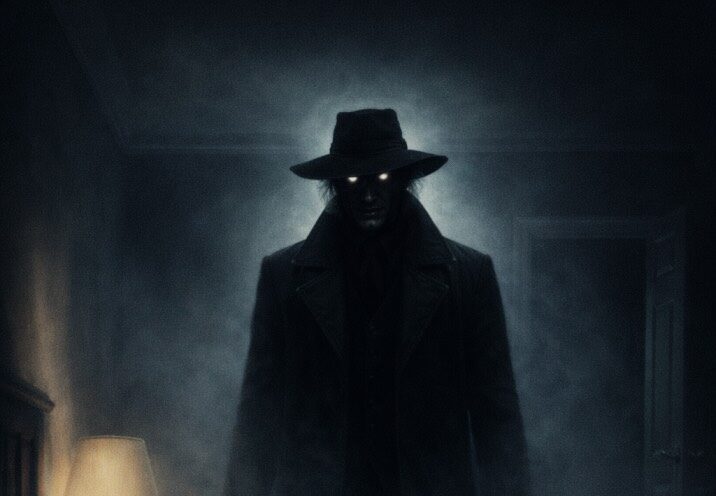
For decades, people across the world have reported waking in the dead of night to find a tall, shadowy man watching from the corner of the room, a figure cloaked in darkness and crowned with a wide-brimmed hat. Known simply as the Hat Man, this unsettling visitor has become one of the most recognizable and debated entities in modern paranormal lore. Some witnesses swear he radiates pure malice, others describe a silent guardian who vanishes as quickly as he appears. From whispered family stories to nationwide radio call-ins, the Hat Man legend has evolved into a chilling cultural phenomenon that blurs the line between sleep, fear, and the supernatural.
Quick overview
- What people report: A tall, shadow-black figure wearing a wide-brimmed hat (fedora, homburg, bowler, or even a stovepipe), sometimes with a long coat or cape. Often motionless, observing.
- Where it appears: Most commonly bedrooms at night, but also hallways, doorways, basements, lonely roads, and occasionally outdoors.
- What it feels like: A surge of dread, the sense of being watched, and sometimes sleep paralysis (awake but unable to move).
- How the myth spread: Family stories and local word-of-mouth for decades, then a true explosion via late-night radio, early internet forums, and modern social media.
- How people explain it:
- Paranormal: an omen, a guardian, a psychic parasite, an interdimensional visitor, or a thought-form.
- Natural: sleep-paralysis hallucinations, pattern recognition in low light, infrasound, suggestion, and carbon-monoxide exposure.
What the Hat Man looks like
Witness descriptions vary, but certain details repeat with striking consistency:
- Silhouette: Very tall (6’–8’ in many accounts), pure black, sometimes flatter than “normal” shadows – as if it has depth but no features.
- Headgear:
- Fedora or homburg: the most common; a modest brim, pinched crown.
- Wide plantation-style brim: a flatter, broader brim that reads “old-timey.”
- Bowler or top hat: less common but reported often enough to be its own subtype.
- Clothing: A trench coat, cloak, or long overcoat. No visible face; a few reports mention glowing red or amber eyes, though most say the face is “emptiness.”
- Movement:
- Frequently still, “studying” the witness.
- When it leaves, it might slip through a wall, dissolve into the corner darkness, or stride away without sound.
Many witnesses insist the figure is not just a trick of light; they describe an intelligent presence and a directed attention, as if it notices that you’ve noticed.
Where the story comes from
Before the internet
- Bedroom visitations – night hags, “old hag” syndrome, and shadowy figures appear in folklore worldwide:
- Newfoundland & the Atlantic coast: “Old Hag” pressing on the chest.
- American South: “hag-riding” during the night.
- Europe: the mara or “night-mare,” a supernatural being that “rides” sleepers.
- Japan: kanashibari, the experience of waking immobilized with a presence nearby.
- The hat detail is the modern twist. In earlier stories, the visitor was a witch, demon, or faceless weight; 20th-century accounts increasingly mention a man in a hat, echoing silhouettes of undertakers, railroad men, or stern authority figures.
The modern surge
- 1990s–early 2000s: Late-night radio, email lists, and message boards collect “shadow people” stories. The Hat Man emerges as a distinct subtype.
- Popular media & online communities: As anecdotes spread, people who had kept silent recognize a match with their own experiences and start reporting them. That feedback loop cements the archetype: tall, dark, brimmed hat, and coat.
Bottom line: The Hat Man legend is old wine in a new bottle, timeless bedroom visitor themes reframed through modern imagery. Be sure to check the sub reddit The Hat Man for personal stories.
Typical U.S. sighting patterns (composites from witness reports)
These are common setups described across the United States:
- Suburbs & small towns (Midwest, Northeast):
- Time: between 2:00–4:00 a.m. Around the witching hour.
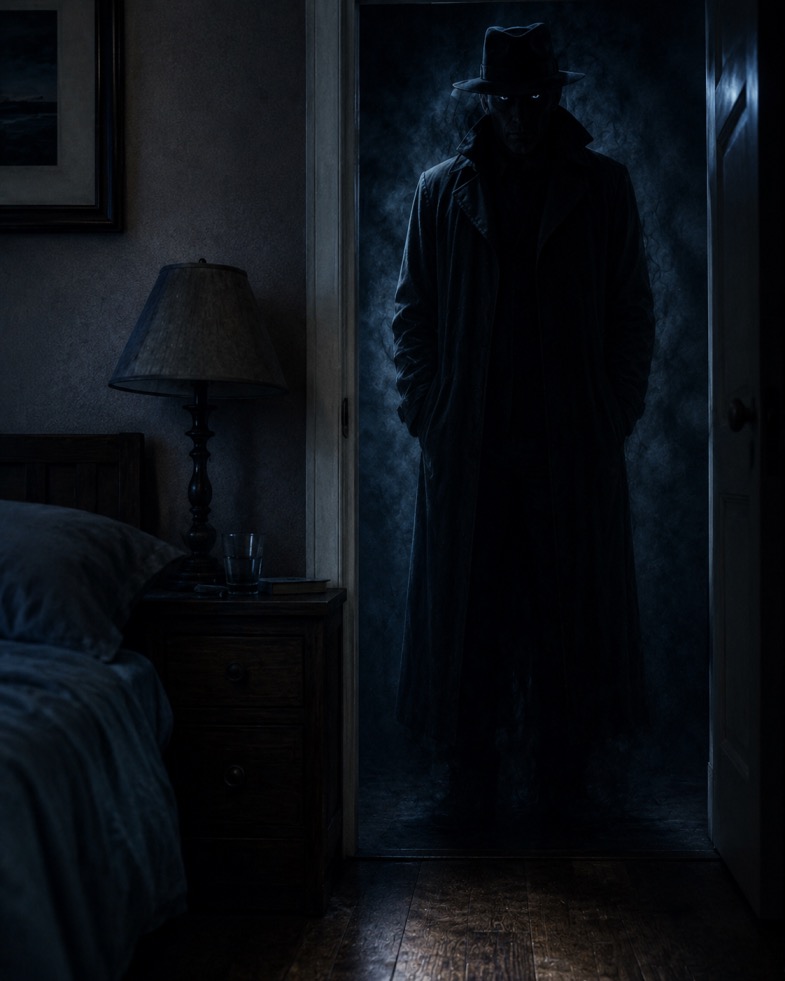
- Scene: A sleeper awakens and sees a man-shaped shadow in the doorway. The brim is obvious. The figure stands, then drifts backward into the hall.
- Apartments & college housing (South, West Coast):
- Witness wakes to a heavy silence, can’t move, and feels a presence to the left of the bed. The Hat Man leans slightly, as if peering, then “thins out” and disappears into the corner.
- Roadside or outdoors (Appalachia, Southwest deserts):
- Drivers spot a brimmed silhouette on a shoulder or ridge line of the road. When the high beams sweep over it, the figure looks “too black” for normal shadow and vanishes without footsteps or dust.
- Childhood bedrooms (across the U.S.):
- Now-adults recall a recurring visitor during ages 6-12, always in the same spot, often at the foot of the bed, sometimes accompanied by clicking, scratching, or a sudden drop in room sound.
Accompanying sensations people mention:
- Sudden wave of fear or “wrongness”
- Pressure on the chest or throat (classic in sleep paralysis)
- Electrical oddities: clocks resetting, a lamp flicker, muted phone audio
- A cold spot near a doorway or closet
Why the hat? Symbolism and psychology
- Authority & judgment: Hats like fedoras and homburgs read as old-world authority – fathers, policemen, undertakers, stern teachers. A faceless judge.
- Archetype of the watcher: In Jungian terms, a shadow-self clothed in cultural power. The mind chooses a shape that communicates “someone has power over you” without details.
- Clarity in low light: A wide brim is one of the easiest silhouettes to recognize at night. Once culture primes people to expect a hat, more people will “see” one.
Paranormal interpretations
People who take the Hat Man as a genuine entity tend to split into a few camps:
- The Omen: Appears around families before illness, loss, or major upheaval. Not necessarily the cause, but a signal.
- The Parasite: Feeds on fear, returns during vulnerable periods, and may be drawn to households with ongoing stress or trauma.
- The Guardian (minority view): A watcher who prevents something worse, standing between the sleeper and other shadow forms.
- The Traveler: An interdimensional or psychic visitor that notices heightened sensitivity (children, insomniacs, experiencers) and simply observes.
What believers often emphasize:
- The consistency of descriptions across regions and decades
- The feeling of intention, as if the figure reacts to being seen
- The way multiple family members sometimes report similar encounters in the same home.
Natural-world and clinical explanations
Skeptical and clinical perspectives explain much of the pattern without invoking the paranormal:
- Sleep paralysis & hypnagogia/hypnopompia
- During transitions into or out of sleep, the brain can briefly keep the body immobilized while the visual system still renders dream imagery in the real room.
- Common features: a presence in the room, pressure on the chest, and hyper-vigilant fear. The mind fills in a recognizable shape; a hat is easy to define in darkness.
- Pareidolia in low light
- Hats, coats on hooks, lamps, and door frames combine into a human outline that the brain “completes” under stress.
- Infrasound
- Very low-frequency vibrations (from HVAC, traffic, wind in ducts) can induce anxiety, chills, and a sense of presence. Infrasound has been linked anecdotally to “haunted room” feelings.
- Toxins & environment
- Carbon monoxide exposure produces headaches, confusion, and visual/auditory hallucinations. Faulty furnaces and space heaters are notorious culprits – always worth checking.
- Suggestion & cultural priming
- Once people learn the Hat Man template, ambiguous night shapes are more likely to be interpreted as a brimmed figure.
Important nuance: these explanations do not disprove every story, but they account for many of the recurring features in a way that’s testable and fixable.
Notable themes in U.S. accounts
- Doorway sentinel: Stands in or just beyond the doorway threshold-liminal spaces matter in folklore and psychology.
- Non-interaction: Rarely speaks. On the few occasions people report words, it’s a short phrase or a hiss. Silence is far more common.
- No footfalls: Movement is often soundless, adding to the unreality.
- Group reports: A spouse or sibling sometimes wakes at the same time and sees the same shape, which experiencers cite as strong support. Skeptics counter with shared expectation and misperception in darkness.
How witnesses cope (practical steps)
If you or your readers have experienced something like this, here’s a grounded, harm-reduction approach:
- Rule out hazards first
- Install/verify carbon-monoxide and smoke detectors.
- Inspect heaters, furnaces, and fireplaces.
- Log times of events and check for HVAC cycles or nearby construction that could cause infrasound or vibration.
- Improve sleep conditions
- Keep a low night light to give your eyes reliable detail.
- Reduce sleep debt, alcohol, and irregular hours-all of which raise sleep-paralysis risk.
- Break paralysis
- Focus on moving one small muscle (a toe, a fingertip).
- Practice slow box breathing: inhale 4, hold 4, exhale 4, hold 4.
- Change the script
- Some experiencers report success by speaking aloud (or thinking firmly): “You don’t belong here. Leave.”
- Others imagine a protective boundary around the bed or room. Rituals vary-use what aligns with your beliefs.
- Document patterns
- Keep a journal: time, diet, stress, room temperature, moon phase, noises, and what exactly you saw or felt. Patterns often emerge.
FAQs and gray areas
- Is the Hat Man always evil?
Not always. Many describe fear, but a subset say the figure felt curious or even protective. Context, expectations, and personal history likely shape the interpretation. - Why do so many people see the same thing?
Shared culture + the way human vision and memory work in low light can produce similar templates. If something paranormal is occurring, a consistent appearance could be a chosen mask. - Why hats from the mid-1900s?
The silhouette signals authority across generations – fathers and grandfathers in Sunday hats, police, undertakers. It’s a powerful, simple symbol the brain recognizes instantly. - Can multiple people see it at once?
Yes, reported; it’s one reason the legend persists. Skeptical explanations point to contagious expectation and the way one person’s exclamation (“Someone’s in the doorway!”) shapes another’s perception.
A balanced take
- The experience is real to the witness. The fear, paralysis, and presence are genuine human events, whether the cause is neurological, environmental, or paranormal.
- The legend coalesced when people found each other’s stories and recognized the same outline: tall, black, brimmed hat, silent watcher.
- The investigation should start with safety (CO detectors, sleep health), then move to environmental testing and psychological understanding. If the experiences persist and the witness prefers a spiritual approach, protective rituals and boundary-setting are reasonable, empowering next steps.
Field checklist (for investigators and homeowners)
- Safety & environment
- Working CO and smoke detectors
- HVAC inspection; note infrasound sources
- Light levels: add a dimmable night light in sightline of the doorway
- Remove hat-like silhouettes (coats, hats on pegs) from corners
- Data & documentation
- Written timeline of events with precise times
- Room map with vantage points and light sources
- Recorder for ambient noise and EMF (if you use those tools)
- Sleep diary noting stress, caffeine, and alcohol
- During an event
- Check movement of one small muscle to break paralysis
- Attempt calm verbal boundary-setting
- Observe details (height relative to doorframe, hat shape, exit path)
- After an event
- Record everything within 5 minutes
- Note household witnesses independently, before cross-talk
- Look for repeatable triggers (time of night, weather, HVAC cycle)
Closing thoughts
Whether you read the Hat Man as a modern archetype of nighttime fear or as something that truly visits, the pattern is undeniable: a watcher in a brimmed hat, lingering at thresholds, drawing out our most primal reactions. If you’ve seen him, you’re far from alone, and there are practical ways to make sense of the experience, reduce its frequency, and reclaim your room at night.
Reader sightings
One reader has told us what happened to them here.
- 1 saw a figure
- 1 felt watched
- Anonymous
This is not my experience but my child’s, for years my child told me of the man out the window with glowing red eyes and long arms and legs with a hat. This man would only get as close as the neighbors shed and that is where he stayed. My child spoke of this for years from about 5yo until 14yo. As a parent I tried to explain it in logical terms. Eventually they stoped telling me about it. I was separated from my X when I had a dream (I do not dream much anymore) that I was at a friends house and a very large red eyed thing was looking in the back window of the house. It stood up and left, for some reason I went to the back door and went outside to see this thing. I caught it and it just looked at me I told it “you do not belong here or anywhere near me or mine” it just turned around and kept walking on its long spider like legs.
After that my kid told me the man was gone, I forgot about the person on the shed. We haven’t had anymore dreams and he has not been seen outside the kids window anymore.


Leave a Reply