
Reviewed by Josh N · Updated July 30, 2026 · How we verify
Reported Phenomena
- Apparitions of girls
- Figures on the roof
- Shapes in the trees
- Murdered students legend
Reported by visitors & local legend. Stories, not verified claims.
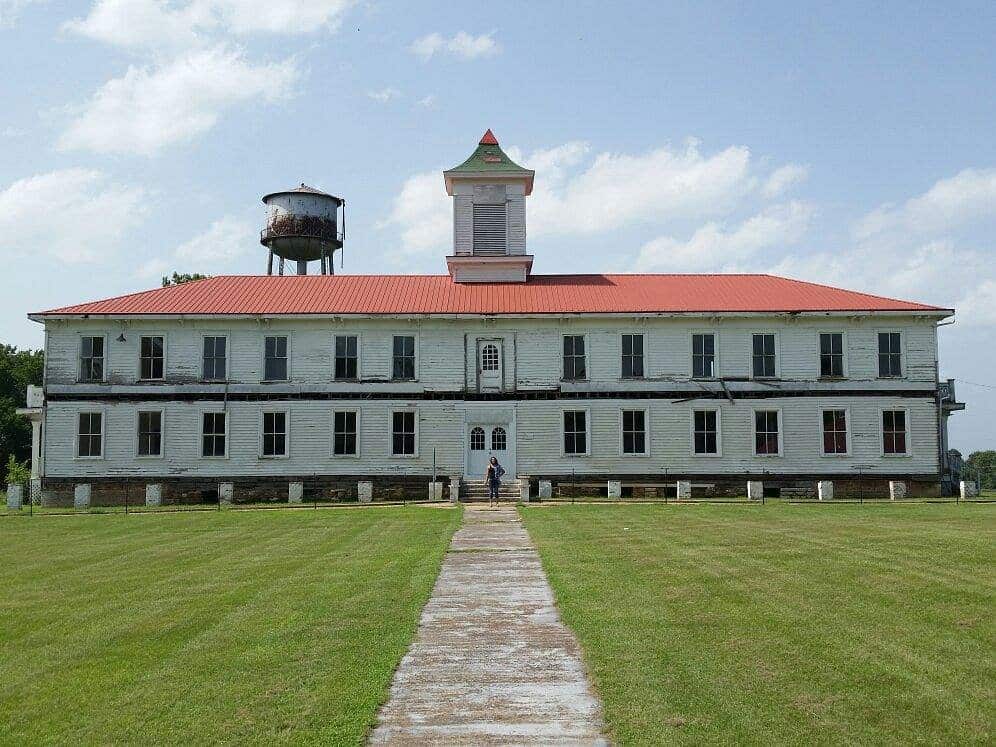
Wheelock Mission sits on a rise above the Little River in southeastern Oklahoma, a mile or so past the water and just high enough to stay dry when the river comes up. The church there is built of stone hauled out of the riverbank by oxen. The school that stood beside it taught Choctaw girls for decades. And the stories that have attached themselves to the place, stories of murdered students and figures in the trees, are not in any of the historical record: they are local lore, repeated by visitors and ghost hunters rather than documented by anyone who was there.
What follows separates the two.
Quick Orientation to Wheelock
- Founded: late 1832, with the first service held on December 9 of that year
- Founders: Alfred Wright (1788 to 1853) and his wife Harriet Bunce Wright (1779 to 1863), Presbyterian missionaries sent by the American Board of Commissioners for Foreign Missions
- Where: near Eagletown, in present-day McCurtain County, southeastern Oklahoma
- Named for: Eleazar Wheelock, first president of Dartmouth College, described in accounts of Wright’s life as a friend
- Reported phenomena: apparitions of girls, figures seen on the roof, shapes in the trees
Harriet Wright Chose the Ground
All Choctaw mission work in Mississippi stopped in 1831, when the Nation was required to sell its homeland and remove to Indian Territory. Alfred and Harriet Wright travelled with a Choctaw party led by Thomas LeFlore and did not reach Indian Territory until September 14, 1832, stopping overnight at the Bethabara Mission near the community of Eagle, now Eagletown.
Alfred was ill again, as he was for much of his life, and could not continue the next morning. He told Harriet to go on ahead with the party and stayed behind at Bethabara. The group moved out along the Military Trace toward Fort Towson, crossed what is now the Little River, known to the Choctaw as Boklusa, or Black River, and found a piece of land about a mile beyond it, above the flood level, with a spring running generously with cold water. Harriet decided to camp there. Others in the party helped her build a cabin. That decision, made without her husband present, fixed the site of Wheelock Mission.
Alfred recovered slowly and caught up in late November. He preached his first sermon at the new site on December 9, 1832, outdoors under a large oak, because there was no building yet. The congregation sat on logs arranged in rows and Wright used an empty 100-gallon barrel, turned upside down, as a pulpit.
The Log Schoolroom That Became Wheelock Seminary
The party built a small log church and a larger log house for the family. Harriet insisted a large room be attached to the house to serve as a day school, and she carried both the teaching and the administrative work with only one other teacher to help her. Alfred, trained in medicine at Williams College before he turned to theology at Andover Seminary, was often away tending Choctaw patients who lived at a distance, and when he was at the mission he was usually writing sermons or translating religious texts from English into Choctaw.
The day school ran until 1839. By then Harriet had concluded it was failing to reach enough children, many of whom lived too far away to walk in daily and could not manage the trip in bad weather even on horseback. She persuaded Alfred to convert Wheelock into a boarding school. A log dormitory went up in 1839 and was expanded over the next three years, with a separate classroom building added. Students paid no tuition. Instead they did the work of running the place: cooking, cleaning, cutting firewood. Class time went to English, arithmetic, reading, writing and Bible study. In 1842 the Choctaw Nation adopted the school into its own system as Wheelock Seminary, devoted exclusively to the education of Choctaw girls.
Jehovah Jireh: The Rock Church of 1845
Wright started the stone church in 1845. Teams of oxen dragged stone up from the banks of the Little River, and the finished walls were 20 inches thick. The floor and belfry were cypress; the roof was covered with sun-cured oak shakes. Into the gable Wright carved the words Jehovah Jireh, “the Lord will provide.” He preached the first sermon inside in the late spring or early summer of 1846.
His illnesses grew more frequent and more severe as he aged, and he kept working anyway, translating until the end. He died on March 31, 1853, and was buried very near the church he built. Harriet tried to keep the school going through 1854, found her own health failing by the close of the school year, and returned east to live with her family. She died on October 3, 1863, in Madison, Florida.
The mission’s institutional life did not end with them. It was sustained with Choctaw Nation funding, suffered badly during the Civil War when schools closed and buildings were damaged, and was rebuilt afterward by the Choctaw community.
The Murdered Girls: Where the Ghost Story Comes From
The haunting attached to Wheelock rests on a single claim: that an intruder killed several girls in the mission dormitory. It is worth being blunt about this. That account circulates as local lore. It is not part of the documented history of the Wrights or of the seminary, and no source consulted for this entry records such a killing. Treat it as a story told about the place, not as an event established by record.
The reported phenomena follow from the story. Visitors and paranormal investigators have described apparitions of girls, figures seated on the roof of the mission, and shapes in the trees, sometimes described as girls hanging from them. These are secondhand accounts rather than verified sightings, and the imagery lines up so neatly with the murder legend that the legend is the likelier parent of the sightings rather than the other way round.
What is documented at Wheelock is grim enough without a killer in the dormitory: a forced removal, a family that arrived sick and stayed anyway, a school built by the labour of the children who attended it, and two graves on the grounds.
If You Go to Wheelock Mission
The site lies near Eagletown in McCurtain County and remains a place of real significance to the Choctaw Nation, with Alfred Wright buried close to the stone church. Access arrangements and hours are not something this entry can confirm, so check locally before travelling and do not assume the grounds are open after dark. Never enter private property or a closed historic site without permission, keep off the graves, and leave the stonework and the carved gable exactly as you found them. A 19th-century mission church is a fragile thing, and it has survived a civil war already.
Sources
- Loc (official)
- Yale (official site)
- Wright, Alfred | Encyclopedia
- Wheelock Academy | Mike Boucher's Web Page
- VIAF
- Wikipedia: Alfred Wright (missionary)
Reader sightings
Nobody has reported anything here yet. If you have been, you would be the first.
Report your own visit to Jehovah Jireh: The Rock Church and Ghosts of Wheelock Mission
How haunted is this place?
Be the first to rate
Leave a Reply