

Reviewed by Josh N · Updated October 4, 2026 · How we verify
Reported Phenomena
- Possession-like episodes
- Lost time
- Following mist
- Short apparition sightings
- Cold spots
Reported by visitors & local legend. Stories, not verified claims.
Water went through Hales Bar Dam almost from the day it was finished, and it never really stopped. The concrete barrier that once spanned the Tennessee River in Marion County, Tennessee, was one of the first major multipurpose dams in the country and one of the first built across a navigable channel, and it was also one of the most stubbornly flawed. Fifty-four years of patching later, the federal government gave up and built a replacement downstream. What remains at the site today is the powerhouse, a marina, and a reputation for ghost stories that has outlived the generators by decades.
Why Anyone Built a Dam in the Tennessee River Gorge
The Tennessee River Gorge was for a long time one of the great obstacles to river traffic in the upper valley, a stretch of fast water and navigation hazards that nineteenth century canal projects never tamed. In 1898 Chattanooga business interests formed the Tennessee River Improvement Association to push for year-round navigation to the city. Around 1900 Major Dan C. Kingman of the U.S. Army Corps of Engineers drew up a design for a dam that would drown the gorge and the current with it.
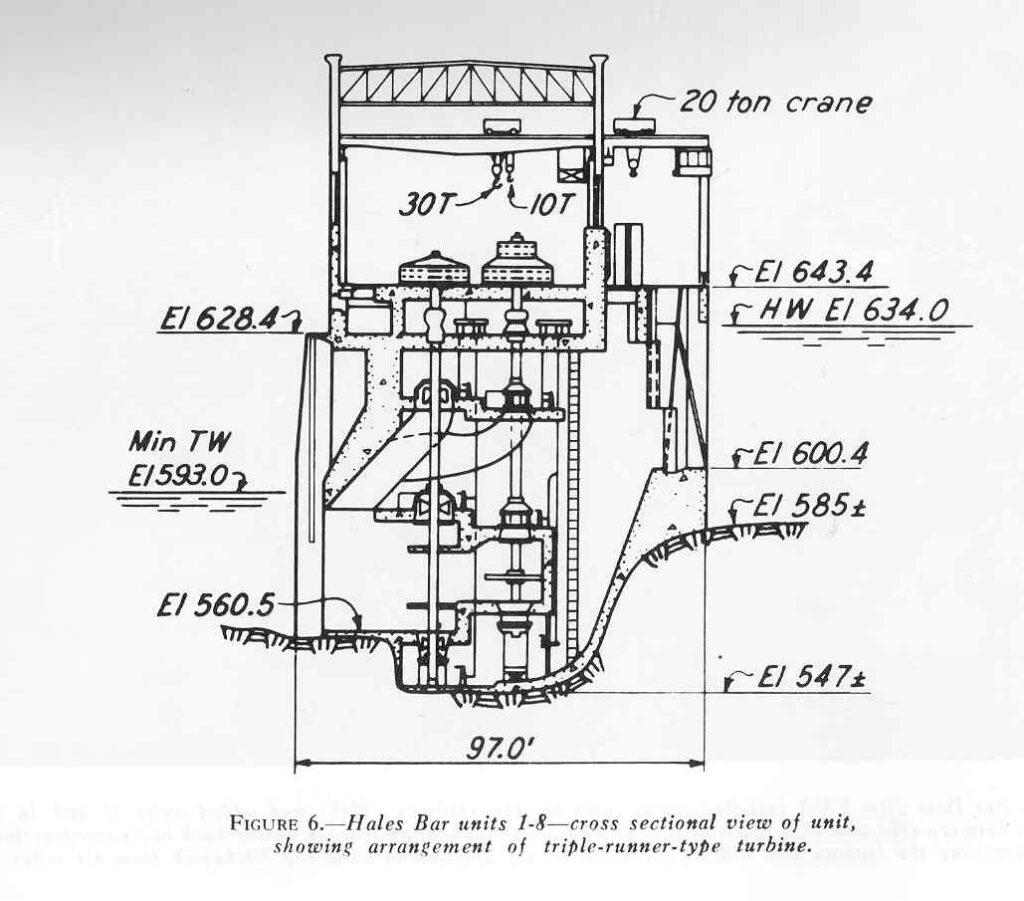
In 1904 Kingman’s friend Josephus Conn Guild offered to build it privately in exchange for the hydroelectric rights. Congress passed the enabling legislation on April 27, 1904, and with money from Chattanooga entrepreneur Charles E. James and New York financier Anthony Brady, Guild formed the Chattanooga and Tennessee River Power Company. The estimate was three million dollars. The final bill came to ten million.
Soft Bedrock, Caissons, and Eight Years of Delay
The contractor William J. Oliver and Company began work in October 1905, with construction formally starting on October 17 of that year. Two self-contained company towns, Guild (now Haletown) and Ladds, were thrown up to house the thousands of workers the job required. The project was supposed to be done by 1909. It was not. The soft bedrock under the dam site stalled the work again and again, and by 1910 only the lock and the powerhouse were standing.
Engineers finally made headway using pressure grouting and concrete caissons, the first use of either technique in a major dam project, and Hales Bar Dam was completed on November 11, 1913. The lock had opened a few days earlier, on November 1, 1913. At 60 by 260 feet with a 41-foot lift, it was the highest lift in the world at the time. The dam itself stood 113 feet high and ran 2,315 feet across the river, and it began operation on November 13, 1913.
Leaks appeared almost immediately. In 1919 engineers pumped hot asphalt into the foundation, which worked for a while. By 1931 a study found the dam leaking at a rate of 1,000 cubic feet per second.
The Deaths Attached to the Construction Years
The grim roster of Hales Bar comes mostly from local telling rather than from the engineering record, and it should be read that way. As the stories are repeated at the site and in regional accounts, the first death came about a year into construction, when a worker was shot by an unidentified assailant. Others followed: a man gravely injured in a fall from a rock crusher, multiple deaths in a boiler explosion, and the murder of two Black workers by white coworkers who were never prosecuted. A project engineer is said to have died of an ear infection. A member of the Hales family, whose land gave the site its name, was reportedly found dead on the railway tracks running to the dam. A further killing is placed in 1912, and in 1913 three workers are said to have fallen into wet concrete and been left entombed in the structure.
No official casualty list for the project is reproduced in the standard histories of the dam, and specific claims like the bodies in the concrete are the kind of detail that attaches itself to every large early twentieth century construction job. Treat them as folklore with a plausible shape rather than as documented fact.
Dragging Canoe and the Curse on the Ground
The oldest layer of the legend has nothing to do with the dam at all. Local tradition holds that the land was cursed by Dragging Canoe, the Cherokee leader, in response to the displacement of his people by settlers. Everything that happened afterward, in this telling, follows from that. There is no contemporary record of such a curse being pronounced, and the story functions mainly as a frame that ties the construction deaths, the leaks and the modern reports into a single narrative.
What TVA Could Not Fix
By the 1930s the original company had merged into the Tennessee Electric Power Company, run by Guild’s son, Jo Conn Guild, a fierce opponent of the newly created Tennessee Valley Authority. With attorney Wendell Willkie, TEPCO fought the constitutionality of the TVA Act all the way to the U.S. Supreme Court and lost in 1939. TVA took control of Hales Bar Dam on August 15, 1939, after buying TEPCO’s assets for 78 million dollars.
TVA then did what no one else had managed: extensive foundation repairs that by 1943 had halted the leakage. In 1949 it raised the generating capacity to 99,700 kilowatts and fitted the spillway with radial gates. The reprieve lasted about a decade. In the late 1950s boils began appearing in the water below the dam, and an investigation found it leaking again at an alarming 2,000 cubic feet per second. Dye tests in 1960 indicated that the leakage channels had interconnected, raising the possibility of outright dam failure.
A 1963 study concluded that enlarging the lock would be ruinously expensive on top of the endless leak repairs, so TVA chose to replace the structure. Nickajack Dam was authorized in January 1963 and completed six miles downstream on December 14, 1967. Hales Bar stopped generating immediately afterward, and by September 1968 the dam had been dismantled so it would not obstruct navigation on the new Nickajack Lake. Two of its generators and parts of its switchyard were moved to Nickajack and put back to work.
What People Report Inside the Powerhouse
The powerhouse survived, and it is where almost all of the reported activity is centered. Investigators who have worked the building describe episodes that they characterize as possession: a loss of awareness and, afterward, no memory of what happened, with normal faculties returning only once the person is taken outside. Visitors also describe a mist that gathers near the moving water and appears to follow people along the structure. A recurring apparition is reported as a small man with short legs, a figure witnesses have compared, unflatteringly, to a video game ghost.
None of this is verified, and a cavernous concrete industrial building sitting over running water produces cold spots, drafts, echoes and condensation without any help from the dead. What can be said is that the reports are consistent enough that people keep coming back to collect more of them.
Visiting Hales Bar Marina and the Powerhouse
The Hales Bar Dam Powerhouse was listed on the National Register of Historic Places in 2008. Since the dam closed, the building has operated as a private event space, and tours can be arranged by reservation rather than simply turning up at the door. A marina has been developed next to the site, and the building currently houses the Dam Whiskey and Moonshine Distillery. If the paranormal reputation is the draw, book ahead: access to the powerhouse interior is controlled, and the ghost stories all live indoors.
See Hales Bar Marina & Dam for Yourself
Sources
- NPGallery Asset Detail (National Park Service)
- Loc (official)
- Measuring Worth – Gross Domestic Product
- Hales Bar Marina – Marina, Lake Resort, Cabin Rentals
- Wikipedia: Hales Bar Dam
Frequently Asked Questions
Can you visit Hales Bar Marina Dam?
Hales Bar Marina Dam is accessible by guided tour only. Always follow posted rules and respect private property.
Reader sightings
Nobody has reported anything here yet. If you have been, you would be the first.
Report your own visit to Dragging Canoe’s Curse and the Leaks at Hales Bar Dam
How haunted is this place?
Be the first to rate
Ghost Tours Nearby
 Murder & Mayhem Haunted History Walking Tourfrom $26
 Cursed in Chattanooga Haunted Walking Tourfrom $35
 Chattanooga Ghosts & Legends: Family-Friendly Walking Tourfrom $30
Affiliate links: BeyondHaunted may earn a commission, at no extra cost to you.

Leave a Reply