
Reviewed by Josh N · Updated October 24, 2026 · How we verify
Reported Phenomena
- Executed deserter's ghost
- Child murder legend
- Cemetery folklore
Reported by visitors & local legend. Stories, not verified claims.
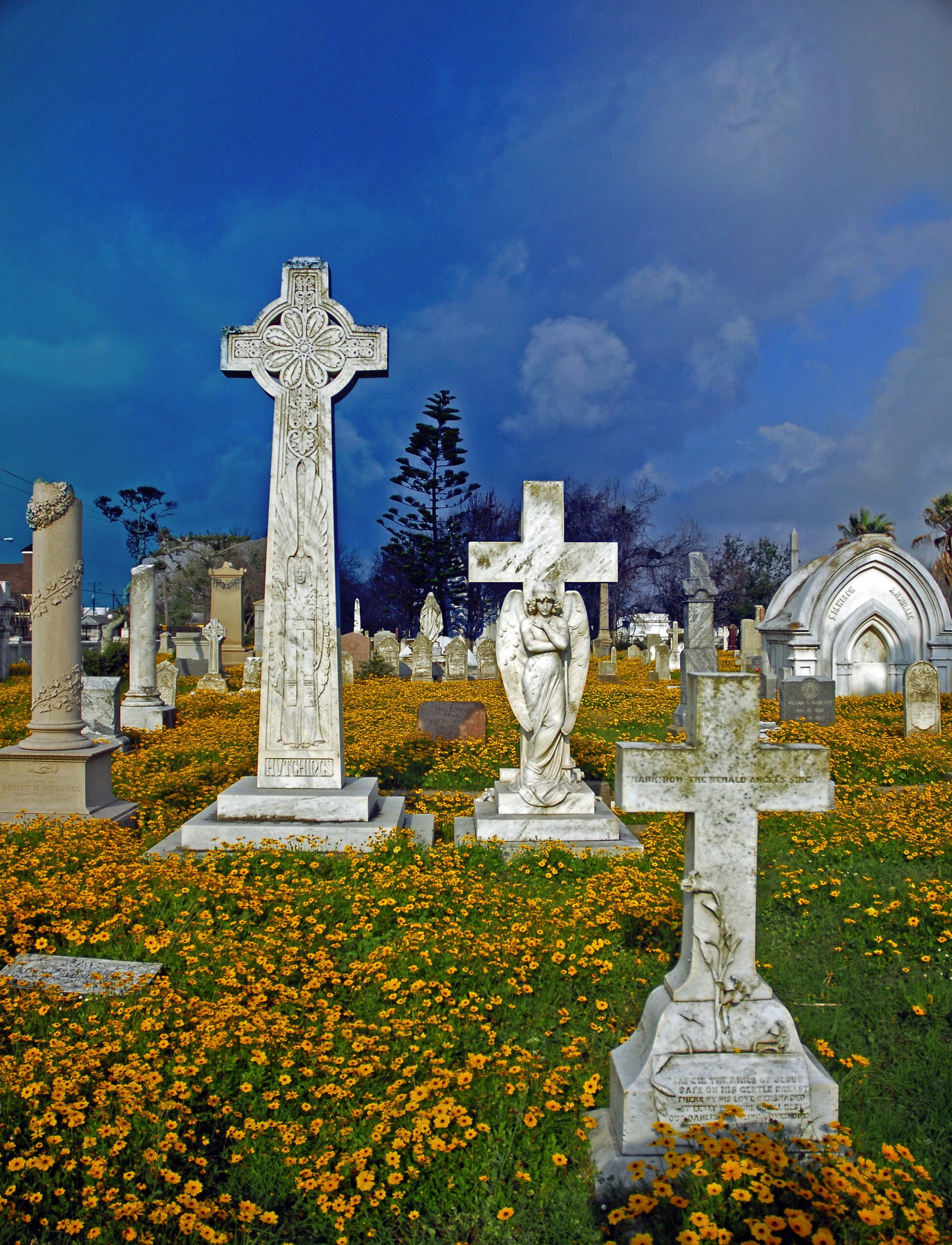
Six blocks of Galveston, Texas, are given over to the dead, and the stories attached to them are older than most of the headstones. The haunted Broadway Cemetery is not one burial ground but seven, laid side by side across 15.27 acres and wrapped in a single cast-iron fence, with roughly 6,000 people interred among them as of 2014. Two of those graves carry folklore. The rest carry something harder to look away from: the arithmetic of epidemic and storm.
The Broadway Cemeteries at a Glance
What it is: a six-block collective of seven separate cemeteries in Galveston, known jointly as the Broadway Cemeteries, covering 15.27 acres. Boundaries: Broadway Avenue to the north, 40th Street to the east, Avenue L to the south, 43rd Street to the west, with Avenue K running through the middle. Burials: about 6,000, roughly 85 percent of them between 1839 and 1864. Status: listed on the National Register of Historic Places on June 13, 2014, and still accepting interments as of 2014, though only sporadically.
Nine Yellow Fever Epidemics and the Need for More Ground
Galveston was the largest city in Texas and the state’s seaport of entry, and ships brought more than cargo. Nine yellow fever epidemics struck the island between 1839 and 1867, and the burial ground had to keep pace. In 1853 an estimated 60 percent of the population was affected, with a death toll of 523. The last epidemic, in 1867, killed hundreds and drove thousands of residents off the island altogether. One resident who stayed described the victims as having “died on the island like sheep.”
Then came the water. The 1900 Galveston hurricane claimed thousands of lives, and the cemeteries were reshaped around that loss. The ground that is now New City Cemetery began as the Old Cahill Cemetery, also called the Yellow Fever Cemetery, with earliest burials dating to 1867; it was expanded in response to the hurricane. Evergreen Cemetery, founded around 1900 as the New Cahill Cemetery or Cahill Yard, existed for the specific purpose of housing hurricane victims. It was renamed Evergreen in 1923.
Seven Burial Grounds Under One Iron Fence
The oldest is Old City Cemetery, established in 1839 under the original town charter, in the northeast corner of the complex, with about 1,500 interments. Oleander Cemetery dates from the same year, opened as Potter’s Field for the unclaimed and the indigent, renamed Oleander by city ordinance in 1939 during the WPA years and reconfigured at the same time. Its southeast corner held Galveston’s earliest Jewish burials. Old Catholic Cemetery was created by the Archdiocese of Galveston-Houston around 1844, Trinity Episcopal Cemetery in 1844 on land deeded to the rector of the Episcopal Church, and the Hebrew Benevolent Society Cemetery in 1868, on ground Isadore Dyer had donated in 1852 for the Jewish Cemetery Association.
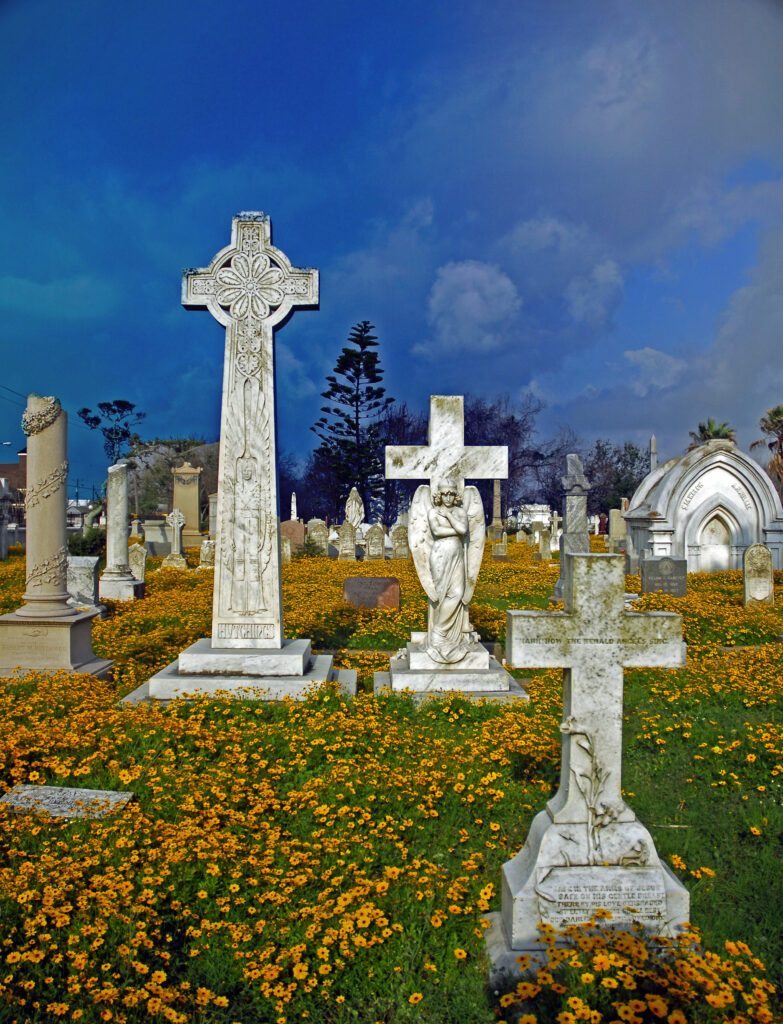
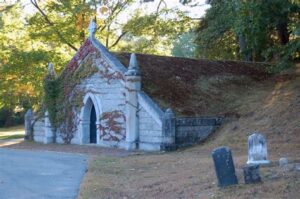
The seven only became one contiguous complex by subtraction. By 1912 the stretch of 42nd Street separating Evergreen and the Hebrew Benevolent Society Cemetery from the rest was closed and removed, and Avenue K was narrowed between 1926 and 1928 to make room for more burials. The result is a district where the boundary lines are legal rather than visible: Beaux Arts, Colonial Revival, Gothic Revival, Neoclassical and Renaissance Revival monuments standing together, family mausoleums in Grecian and Roman Revival styles, and markers carved with lambs, willow trees and flowers alongside religious, ethnic and fraternal symbols.
Thomas Nicaragua Smith and the Alberti Graves
Old City Cemetery is where the ghost stories live, and it is worth being precise about what they are. Thomas Nicaragua Smith was executed as a deserter from the Confederate Army during the American Civil War, and the cemetery is alleged to be haunted by him. That allegation is folklore attached to a documented execution, not a documented haunting. Nothing in the historical record of the district establishes anything beyond the fact that the story is told and retold.
The second story belongs to Elize Alberti, whose remains and those of her family lie in the same cemetery. She is alleged to have murdered her own children. Again, the source material records this as legend rather than finding. It is the kind of claim that hardens into fact through repetition on walking tours, and visitors standing at the plot should understand they are looking at an accusation carried by rumor.
What People Actually Report Here
Compared with the big marquee hauntings of the Texas coast, the reported phenomena at the Broadway Cemeteries are thin and specific. The district’s own history is described as the source of rumors and folklore, with the hauntings centered on Old City Cemetery and on those two names. There is no catalog of apparitions, cold spots or recorded voices in the historical documentation of the site. What exists is a reputation, built on an executed soldier and a woman accused of something terrible, in a burial ground that absorbed the dead of nine epidemics and a hurricane. Anyone who tells you more than that is adding to the story rather than reporting it.
Who Lies Along Avenue K
The names in these plots are a shortcut through Texas history. Michel Branamour Menard, founder of Galveston, is in Old City Cemetery, as is the actress Charlotte Walker. Trinity Episcopal holds George Childress, author of the Texas Declaration of Independence; John Melville Allen, the first mayor of Galveston; Warren D. C. Hall, Secretary of War for the Republic of Texas; Samuel May Williams; Confederate senator Louis Wigfall; general John B. Magruder; and Edward Lea, the United States Navy officer killed in the Battle of Galveston. George F. Robie, a Civil War veteran and Medal of Honor recipient, lies in New City Cemetery. Memorials in the district mark Confederate casualties, Republic of Texas founders and veterans, and the 1861 sinking of the USS Varuna.
Walking the Broadway Cemeteries
The district is open ground in a residential stretch of Galveston, bounded by Broadway, 40th Street, Avenue L and 43rd Street, with gates set at intervals along the bordering streets. Avenue K splits it: Old City, Oleander and Evergreen on the north side, New City, Old Catholic, Trinity Episcopal and Hebrew Benevolent on the south. These are active cemeteries, still taking occasional interments as of 2014, and most post-1940 burials have gone into Oleander and Old Catholic. Treat them accordingly. The monuments are the reason to come, and the ghost stories, such as they are, will keep whether you find Thomas Nicaragua Smith’s corner of Old City or not.
Address: Bounded by Broadway Avenue, 40th Street, Avenue L and 43rd Street, Galveston, Texas
Sources
- Broadway Cemetery Historic District (National Park Service)
- Epidemic Diseases
- Yellow Fever in Galveston, Texas – "Those Remaining Died on the Island like Sheep"
- Ghost of Nicaragua Smith Haunts Old City Cemetery in Galveston
- Is Galveston’s Old City Cemetery the Most Haunted Graveyard in Texas?
- Wikipedia: Broadway Cemetery Historic District
Frequently Asked Questions
Where is Broadway Cemeteries Galveston Island located?
Broadway Cemeteries Galveston Island is located at Bounded by Broadway Avenue, 40th Street, Avenue L and 43rd Street, Galveston, Texas.
Can you visit Broadway Cemeteries Galveston Island?
Broadway Cemeteries Galveston Island is open to the public. Always follow posted rules and respect private property.
Reader sightings
Nobody has reported anything here yet. If you have been, you would be the first.
Report your own visit to Seven Cemeteries, Six Blocks: Haunted Broadway Cemetery, Galveston
How haunted is this place?
Be the first to rate
Ghost Tours Nearby
 Haunted Harbor Tours – Galveston Ghost Boatfrom $56
 Galveston Haunted Pub Crawl Walking Tourfrom $35
 The Historic Galveston Ghost Tourfrom $33
Affiliate links: BeyondHaunted may earn a commission, at no extra cost to you.
Leave a Reply