
Reviewed by Josh N · Updated September 3, 2026 · How we verify
Reported Phenomena
- Spectral figures
- Cold spots
Reported by visitors & local legend. Stories, not verified claims.
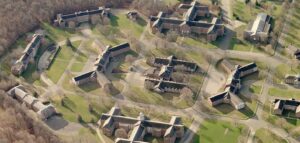
Eloise Psychiatric Hospital was never one building. At its height it was a self-contained town on the western edge of Wayne County, Michigan, with its own police force, fire department, railroad, bakery and dairy herd, and roughly 10,000 residents living behind its walls. Most of it is gone now, buried under a strip mall, a golf course and condominiums. What survives is a handful of brick structures in Westland, a historic marker, and a reputation for hauntings that has drawn film crews, ghost hunters and paying visitors to the site.
Quick orientation: the complex sat in what is now Westland, Michigan. The hospital was named for Eloise Dickerson Davock, the daughter of Detroit’s postmaster. Today the site is a designated historical landmark and operates attractions including haunted houses, escape rooms and history tours.
From the Black Horse Tavern to the Wayne County Poor House
The institution’s roots reach back to 1832, when the Wayne County Poor House was founded at Gratiot and Mt. Elliott Avenues in Hamtramck Township, two miles outside the Detroit city limits. By 1834 that building was in bad condition, and the county bought 280 acres in Nankin Township. On the new land stood the Black Horse Tavern, a stagecoach stop on the route between Detroit and Chicago. The trip out from Hamtramck Township took two days by stagecoach.
The register records that on April 11, 1839, thirty five people were transferred from the old poorhouse to the new one. One hundred eleven apparently refused to go to what they called the “awful wilderness.” Many of those were children, and homes may have been found for them among city residents. The log cabin that had been the tavern became the keeper’s quarters, and in 1839 an A-frame building went up to house the inmates, a term better rendered today as patients. A separate A-frame cookhouse behind it served inmates, staff and the keeper’s family alike.
A County Institution That Ran Its Own Railroad
The complex that grew from those two frame buildings was designed to need nothing from outside. It had police and fire departments, a railroad and trolley system, a bakery, an amusement hall, a laundry, a post office and a power plant. The farm operation included a dairy herd, dairy barns, a piggery, a root cellar, a tobacco curing building and greenhouses.
It was also, for a time, a genuine medical center. Patients came in from Detroit and other communities for x-rays. Eloise housed the first kidney dialysis unit in the state of Michigan and pioneered the use of music therapy. Alongside that, staff used hydrotherapy, shock therapy and insulin therapy, the standard and now heavily criticized psychiatric arsenal of the era.
The population tracked the growth of metropolitan Detroit. From 35 residents in 1839, Eloise reached about 10,000 at its peak during the Great Depression. The decline took forty years. Farm operations ceased in 1958. Some of the large psychiatric buildings were vacated in 1973. The psychiatric division began closing in 1977, and the last patients were transferred out in 1982 when the State of Michigan took over. The general hospital closed in 1986.
Elijah McCoy and the Names on the Register
The inventor Elijah McCoy is probably Eloise’s best known former resident. He spent the year before his death as a patient in the Eloise Infirmary. Several professional baseball players also died there, among them Jul Kustus, Larry LeJeune, Charlie Krause and Marty Kavanagh. The musician Horace Flinders was a patient and received music therapy.
The scale of the place is the reason its stories persist. Steve Luxenberg’s book Annie’s Ghosts: A Journey Into a Family Secret deals with the author’s aunt, committed to Eloise in the 1940s and kept a family secret, which is as good an illustration as any of how many lives passed through here quietly.
What Is Left Standing in Westland
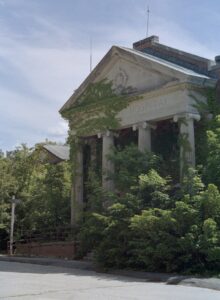
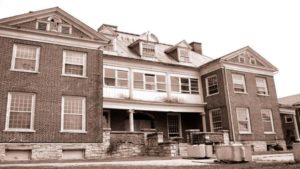
The “D” Building, known as the Kay Beard Building, remains in use. It handled psychiatric admissions, held 400 patients and included living quarters for some employees, among them the Catholic chaplain. Wayne County administration occupied it until 2016. The old commissary building now serves as a family homeless shelter.
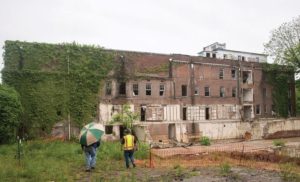
The firehouse, which was previously the psychiatric facility’s laundry, and the power plant also survive. As of June 2025 the firehouse shell has been restored and is used for storage, while the power plant is slated for demolition because of structural damage. The bakery was heavily damaged by arson in April 2016 and only the foundation and scattered debris remain. The famous smokestack with ELOISE spelled out in brick was judged a hazard and demolished in 2006.
Nearby, the Walter P. Reuther Psychiatric Hospital opened in 1979 at the northwest end of the former Eloise property, just southeast of Merriman and Palmer Roads, and is operated by the Michigan Department of Community Health. In 1996 Oakwood Health System, later merged into Beaumont Health, opened the Adams Child & Adolescent Health Center on the corner of Merriman and Palmer.
The Haunted Reputation of Eloise and Eloise Cemetery
Here the record thins out considerably. The site and the adjoining Eloise Cemetery are reputed to be haunted. That is the extent of what the documentary record supports: a reputation, not a catalog of verified events. No specific apparition, cold spot or recorded voice has any evidentiary standing here, and anyone claiming otherwise is repeating television or local lore rather than history.
What Eloise does have is media attention. It inspired the 2017 horror film Eloise, starring Eliza Dushku, Robert Patrick and Chace Crawford, released on February 3, 2017 by Vertical Entertainment. It was the subject of Expedition X: Ghosts of Eloise Asylum Parts 1 and 2, released August 9, 2023 with Josh Gates, Phil Torres and Jessica Chobot, and it appeared in the second episode of Ghost Brothers: Lights Out, titled “Dead and Forgotten.” That coverage has done more to shape expectations of the place than any account from a former patient or employee.
Planning a Visit to the Eloise Site
Eloise is a rare case of an abandoned asylum that you can actually enter legally. The site is marked by a Michigan Historic Marker and offers a range of attractions: haunted houses, escape rooms and history tours. The history tours are the option worth prioritizing if you want the institutional story rather than a jump scare, and the surviving buildings are far more interesting once you understand how small a fraction of the original complex they represent. The rest of the grounds are now private commercial and residential development, so the strip mall, golf course and condominiums are not places to go looking for ghosts.
Address: Westland, Michigan
See Eloise for Yourself
Sources
- History of Eloise
- Eloise Dickerson Davock
- History of Eloise
- Genius In An Asylum 1946
- Walter P. Reuther Psychiatric Hospital (Michigan (official))
- Wikipedia: Eloise (psychiatric hospital)
Frequently Asked Questions
Where is Eloise Psychiatric Hospital Westland located?
Eloise Psychiatric Hospital Westland is located at Westland, Michigan.
Can you visit Eloise Psychiatric Hospital Westland?
Eloise Psychiatric Hospital Westland is accessible by guided tour only. Always follow posted rules and respect private property.
Reader sightings
Nobody has reported anything here yet. If you have been, you would be the first.
Report your own visit to Ten Thousand Residents: Eloise Psychiatric Hospital, Michigan
How haunted is this place?
Be the first to rate
Ghost Tours Nearby

Affiliate links: BeyondHaunted may earn a commission, at no extra cost to you.

Leave a Reply