Reviewed by Josh N · Updated September 20, 2025 · How we verify
This article covers safety steps, psychological and environmental explanations, and the history of “abduction” reports. It is informational only—not medical, legal, or professional advice. If you feel unsafe or are experiencing frightening symptoms, contact local emergency services or a licensed healthcare professional.
TL;DR
Reports of “alien abduction” are complex experiences that often mix vivid waking or sleep-related phenomena, memory/recollection effects, and cultural framing. Practical prevention focuses on sleep health, safety checks, stress reduction, and careful documentation. When people seek help, responsible clinicians and researchers emphasize ruling out sleep disorders, neurological or psychiatric causes, and environmental hazards before treating experiences as literal extraterrestrial events. Appalachian State University
Table of Contents
- What “Alien Abduction” Reports Usually Involve
- First: Safety & Medical Basics
- Sleep, Physiology & The Most Common Natural Explanations
- Practical Prevention Steps (Actionable)
- Memory, Hypnosis & Therapy — Cautions and Best Practices
- Cultural Context & History of High-Profile Researchers
- When to Seek Professional Help
- Quick FAQ
1) What “Alien Abduction” Reports Usually Involve
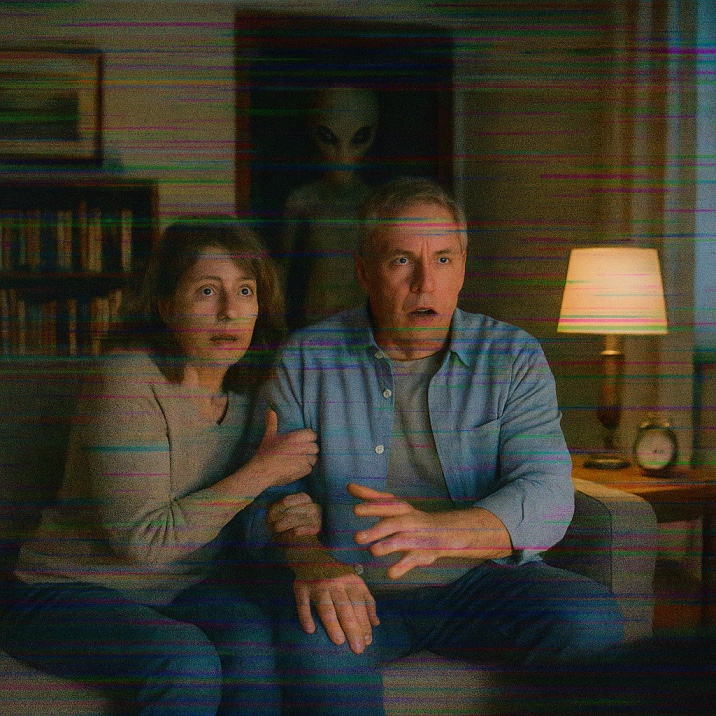
People who describe alien abduction typically report elements such as:
- waking up in bed with a sense of paralysis and vivid imagery;
- missing time or sudden memory gaps;
- sensations of being moved, examined, or subject to medical-like procedures;
- sometimes corroborating secondary signs (bruises, marks) reported by the experiencer.
Scholars emphasize that these accounts are heterogeneous—some contain corroborating external observations, many are best explained by sleep-related and psychological processes, and all are shaped by cultural narratives about aliens and UFOs. Wikipedia
2) First: Safety & Medical Basics
Before interpreting anything as a literal abduction, rule out medical and environmental hazards:
- Sleep disorders: narcolepsy and REM-sleep-behavior disorders can produce vivid intrusions and acting out of dreams. Get a sleep clinic evaluation if symptoms are frequent. Appalachian State University
- Neurological checks: seizures, temporal-lobe activity, or other brain conditions can cause unusual sensory experiences; a neurologist may recommend imaging or EEG.
- Substances & medications: certain prescriptions, over-the-counter drugs, alcohol withdrawal, or recreational substances can induce hallucinations or memory gaps.
- Physical safety: if you find unexplained marks or your environment is unsafe (broken locks, structural problems), secure the premises and call local authorities if there’s risk.
These actions are not “dismissive” — they’re practical steps that protect health and create a stable baseline for any further investigation.
3) Sleep, Physiology & The Most Common Natural Explanations
A large body of research links many abduction reports to sleep-related phenomena, especially sleep paralysis: a transient state when REM atonia (muscle paralysis during dreaming) persists into wakefulness, often accompanied by vivid hallucinations (visual, auditory, tactile) and a terrifying sense of presence. Experimental and clinical reviews have shown striking overlap between classic abduction motifs (e.g., immobilization, perceived presence, contact) and sleep-paralysis experiences. Appalachian State University
Other contributing factors include:
- Hypnagogic or hypnopompic hallucinations (on falling asleep or waking).
- False memory creation during suggestive interviewing or inappropriate use of hypnosis (documented concerns in abduction research). PMC
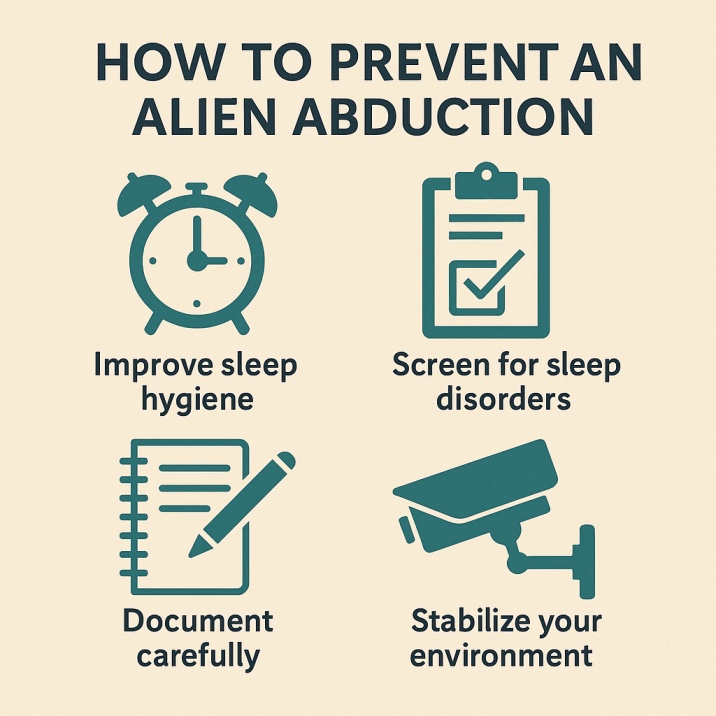
4) Practical Prevention Steps (Actionable)
If you’re worried about abduction-type experiences, these pragmatic steps reduce risk and improve well-being:
- Improve sleep hygiene
- Fixed sleep schedule, avoid screens 60–90 minutes before bed, avoid heavy alcohol or sedatives near bedtime, and treat insomnia promptly. Better REM regulation reduces sleep-paralysis occurrences. Appalachian State University
- Screen for sleep disorders
- If you have frequent episodes of paralysis, vivid hallucinations, or “missing time,” request a referral to a sleep medicine specialist for polysomnography or other tests. Appalachian State University
- Document carefully (nonleading log)
- Keep a dated, objective journal: what you felt, exact time, what you were doing beforehand, lights/noise, medication, and any marks found. Do not let others suggest or “fill in” details before you record them. Objective logs help clinicians and investigators separate patterns from embellished recollection.
- Limit suggestibility
- Avoid consuming sensational media or online forums right after an episode; strong exposure to abduction narratives can shape how you recall or interpret experiences. When seeking help, choose clinicians who avoid leading questions and who follow ethical interviewing standards. PMC+1
- Stabilize your environment
- Improve home safety (locks, cameras if helpful for peace of mind), fix strange noises, test for intoxication sources (drugs, alcohol), and ensure household members know to maintain calm after an episode. Recording ambient conditions (sound/temperature) can explain many “mysteries.”
- Community & mental-health support
- High stress, grief, and isolation amplify anomalous experiences. Counseling, peer support groups (non-sensational), and routines reduce vulnerability.
- If you want corroboration, use objective tools
- Motion-trigger cameras, time-lapse recording, and door/window sensors can capture environmental events—useful for distinguishing perceived abduction from physical disturbances. Be mindful of privacy and legality when recording others.
5) Memory, Hypnosis & Therapy — Cautions and Best Practices
Some high-profile abduction research used hypnosis to “recover” missing memories. Clinicians and scientists now caution that hypnosis increases suggestibility and can produce confabulations or false memories if the interviewer is leading or biased. Responsible practice includes:
- Prioritizing medical and sleep assessments first.
- If psychotherapy or regressive work is considered, use clinicians trained in trauma-informed care who explicitly avoid suggestive techniques and document consent and methods. PMC
6) Cultural Context & History of High-Profile Researchers
Several prominent researchers and clinicians brought attention to abduction reports in the late 20th century:
- Budd Hopkins and others collected many abductee narratives and popularized an abductee lexicon; his methods and conclusions were later criticized for methodological problems and potential suggestiveness. tricksterbook.com
- John E. Mack, a Harvard psychiatrist, interviewed hundreds of experiencers and argued for taking reports seriously as meaningful human experiences. Mack’s work was influential but also controversial—Harvard reviewed his practices because of concerns about hypnosis and clinical boundaries. His work remains central to understanding why many people report transformational effects after these experiences. PMC
Reading critiques and defenses together helps form a balanced view: there are powerful, consistent motifs in many reports, but methodological caution is essential. Vanity Fair+1
7) When to Seek Professional Help
- Immediate: If you experience ongoing confusion, suicidal ideation, loss of safety, or physical injury, call emergency services or a crisis line.
- Sleep clinic / neurologist: Frequent sleep paralysis, daytime sleepiness, or suspected seizure activity. Appalachian State University
- Mental-health professional: When episodes cause distress, impair daily functioning, or follow trauma. Choose clinicians who follow evidence-based, nonleading interviewing practices.
- Legal/safety: If there is evidence of a break-in, physical interference, or someone is tampering with your environment, involve local law enforcement.
8) Quick FAQ
Q: Can I prevent abductions completely?
A: There’s no documented, evidence-based method to “stop extraterrestrials”; most prevention is about reducing physiological and psychological risk factors that underlie abduction-type experiences—sleep health, stress reduction, medical screening, and environment control. Appalachian State University
Q: Are there documented “proof” cases?
A: A few reports include secondary corroboration (witnesses, short-term absences), but the larger scientific consensus emphasizes nonextraordinary explanations (sleep, psychology, suggestion). Researchers remain divided, and rigorous, repeatable objective proof is lacking. Wikipedia
Q: Is hypnosis safe for my case?
A: Hypnosis carries special risks for false memory creation and should only be performed by clinicians who explicitly avoid suggestive questioning and who have clear ethical protocols. Consider alternatives first. PMC
Sources & Further Reading
(Selected high-quality overviews and critiques you can read for more context.)
- “Alien abduction” — encyclopedic overview. Wikipedia
- Blackmore, Susan: Abduction or Sleep Paralysis? (paper discussing sleep-paralysis explanations). Appalachian State University
- John E. Mack — Harvard psychiatrist and abduction researcher (biography and critique). PMC
- Vanity Fair, “Alien Nation: Have Humans Been Abducted by Extraterrestrials?” (longform cultural feature). Vanity Fair
- PBS/NOVA resources and public discussion about abduction claims and skepticism. PBS
Bottom Line
If you’re worried about alien abduction, treat it like any alarming human experience: protect your health and safety first, rule out common physiological and environmental causes (especially sleep disorders), reduce stress, document objectively, and consult responsible, ethical clinicians who avoid leading techniques. Most people who take these steps find fewer episodes and regain a sense of control—regardless of how they ultimately interpret what happened. Appalachian State University
Reader sightings
Nobody has reported anything here yet. If you have been, you would be the first.
Leave a Reply