

Reviewed by Josh N · Updated May 14, 2026 · How we verify
Reported Phenomena
- Cold spots
Reported by visitors & local legend. Stories, not verified claims.
Dead Woman’s Crossing is one of Oklahoma’s most unsettling haunted locations, not because of an old building or staged ghost tour, but because the name comes from a real tragedy. Located northeast of Weatherford in Custer County, the site is tied to the 1905 murder of Katie DeWitt James, a young mother whose death became one of Oklahoma Territory’s most disturbing unsolved stories.
Location details:
- Location: N Dead Women Rd, Weatherford, Oklahoma 73096
- Coordinates: 35.568029, -98.650411
- General directions: From I-40 exit 84, travel north about half a mile, then east about a quarter mile, then north on the blacktop road about half a mile to the bridge area.
- Hours: No official posted visitor hours found
- Admission: Free roadside location
- Important note: This is a rural bridge and creek crossing area, not a staffed attraction. Respect local property, traffic, weather, and road conditions.
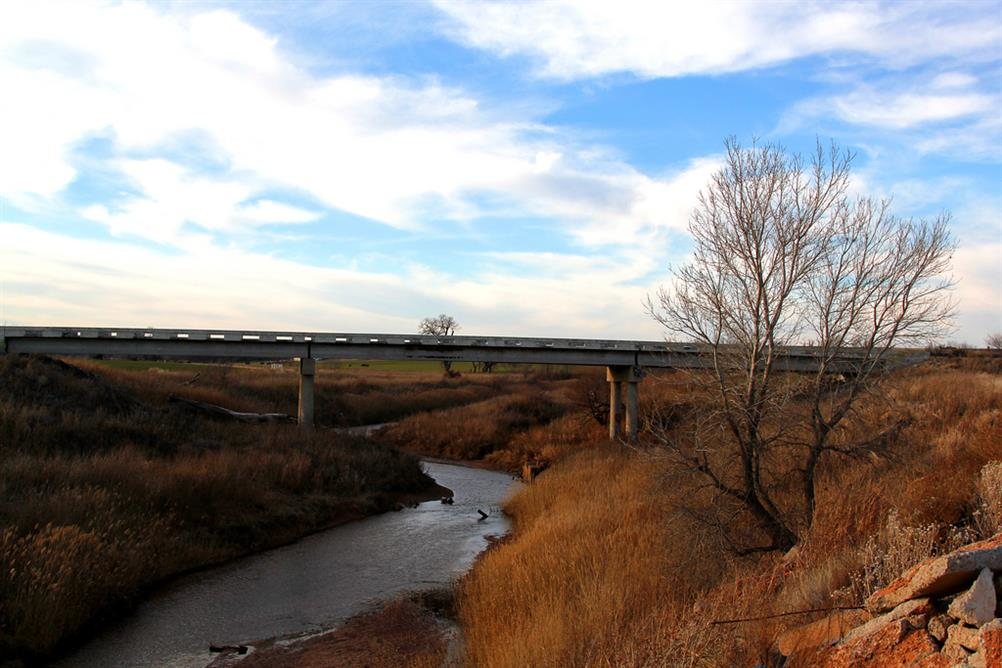
The current concrete bridge is not the original wooden crossing, but the area still carries the name and the story. The Oklahoma Historical Society’s Chronicles of Oklahoma describes the location as about six miles northeast of Weatherford, across Big Deer Creek, where a plaque once identified the place as “Dead Woman’s Crossing, 1905.”
The Real Woman Behind Dead Woman’s Crossing
The “dead woman” was Katie DeWitt James, sometimes spelled Katy in later retellings. She was 29 years old in July 1905, a former schoolteacher, a homesteader, a mother, and a woman attempting to leave a troubled marriage. According to Sue Woolf Brenner’s 1982 historical article in Chronicles of Oklahoma, Katie boarded a train at Custer City on July 7, 1905, with her 14-month-old daughter, Lulu Belle. She was traveling to visit her cousin, Wellington Knight, in Ripley, Oklahoma Territory. The day before, Katie had filed for divorce from her husband of four years, Martin Luther James, citing “cruelty.”
Her father, Henry DeWitt, saw her off at the station. Her husband did not. That detail became part of the unease surrounding the case, especially after Katie failed to arrive and weeks passed without a letter or message.
Katie was not simply a passive figure in someone else’s story. Historical accounts show she had owned land before her marriage, had worked as a teacher, and was in the process of reclaiming control over her life. That makes what happened next even more tragic.
Katie James Disappears
When Henry DeWitt did not hear from Katie, he contacted authorities and eventually hired detective Sam Bartell to search for his missing daughter and granddaughter. Bartell’s investigation led him from Clinton to Weatherford, where he began piecing together Katie’s last known movements.
According to Bartell’s later testimony, he discovered that a woman matching Katie’s description had stayed overnight with a woman named Fannie Norton at the home of William Moore, Norton’s brother-in-law. Norton was also known locally as “Mrs. Ham.” The next morning, Katie, her baby, and Norton left in a rented buggy. Norton reportedly said they would return in about three hours. Instead, Norton returned alone.
Witnesses later placed the buggy near Big Deer Creek. The two women and the child were seen entering a field near the creek. After roughly 45 minutes, only one woman came out. That woman was Fannie Norton. She drove away at high speed, later leaving baby Lulu Belle with a boy at a nearby farmhouse. The child was alive, but she was wearing a blood-covered dress. Blood was also later noticed on one wheel of the buggy.
Those details turned a missing persons case into a suspected murder.
Fannie Norton’s Strange Story
Bartell tracked Fannie Norton to Shawnee. When questioned, Norton gave a confusing explanation. She claimed that she and Katie had met a man in a covered wagon after leaving Weatherford and that Katie had willingly climbed into that wagon. Bartell did not believe her.
When Bartell accused Norton of killing Katie, Norton denied it and became extremely upset. Later that night, while in police custody, she began vomiting. Doctors concluded that she had taken poison, possibly morphine, cocaine, or strychnine, depending on the account. She died without regaining consciousness. Her death was ruled a suicide.
That suicide froze the case in place. Norton was the obvious suspect, but Katie’s body had not yet been found. Investigators had a likely killer, a surviving baby, blood evidence, and a suspicious final buggy ride, but no victim.
The Search for Katie James
Search parties combed the area around Deer Creek. Rewards were offered. Henry DeWitt offered money for his daughter’s return alive or for the recovery of her body. Oklahoma Territory Governor Thompson Benton Ferguson also offered a reward for the arrest of whoever murdered Katie James. Despite organized searches involving dozens of men, no body was found at first.
This became one of the most puzzling parts of the case. The suspected murder area was known. The field and creek had been searched. Yet Katie remained missing for weeks.
Then, on August 31, 1905, G.W. Cornell went fishing with his sons near Deer Creek. When he stepped out of his buggy, he noticed a skull near his foot. Katie’s skeleton was found about three feet away. Her clothing, hat, hair comb, hairpins, shoes, and a gold ring helped identify her. Her father confirmed the remains belonged to his daughter.
The skull had a bullet hole behind the right ear, and a .38 caliber bullet was found inside. A .38 caliber revolver, identified as Fannie Norton’s, was found near the body with one empty cartridge and one loaded cartridge. Cornell’s account stated that the course of the buggy could be followed through broken brush, suggesting Katie had been shot while in the buggy and had fallen from it.
Was the Murder Really Solved?
The coroner’s jury concluded that Katie James died from a gunshot wound fired from a .38 caliber pistol in the hands of Fannie Norton on or about July 8, 1905. The commonly reported motive was robbery. Some accounts claimed Katie had shown a pocketbook containing about $23 while staying at the Moore home.
But the official conclusion never answered every question.
The problems with the robbery theory are hard to ignore:
- Katie was reportedly still wearing a gold ring when her remains were found.
- No clear record confirms whether her money was actually missing.
- Norton’s behavior after the murder was frantic and strange.
- Katie’s body was not found during earlier organized searches.
- Some people at the time wondered if Norton had an accomplice.
- Katie’s husband, Martin Luther James, had a motive to resent the divorce, but he was reported to have established his whereabouts during the critical period.
The Chronicles of Oklahoma article is careful about this point. It does not claim proof of an accomplice, but it notes that gaps in the evidence remained. The fact that Katie’s body was found in plain sight after earlier searches failed raised questions that were never fully resolved.
Martin James was questioned during the inquest and reportedly “showed no sorrow” and had not helped search for Katie’s body, according to local newspaper commentary quoted in the Oklahoma Historical Society article. However, the same account states that he proved his whereabouts for the relevant time period.
That leaves the case in a strange place. Legally and historically, Fannie Norton was identified as the killer. Folklore, however, has never been fully satisfied with that answer.
What Happened to Lulu Belle?
Lulu Belle survived. She was the baby left at the farmhouse in a bloodied dress. After Katie’s death, Martin Luther James eventually took custody of his daughter and became involved in settling Katie’s estate. Records cited in Chronicles of Oklahoma state that Katie’s estate was divided between Martin James and Lulu Belle, and that Martin later petitioned for guardianship. He remarried in 1907, sold the farm, left Oklahoma, and disappeared from the historical record.
That detail adds another painful layer to the story. Katie’s child lived, but the historical trail of the family became murky. Like so much about Dead Woman’s Crossing, the known facts stop just short of emotional closure.
The Original Crossing and the Modern Bridge
The original crossing near where Katie’s body was found was a wooden wagon crossing over Big Deer Creek. That older crossing was eventually removed. Atlas Obscura notes that the wooden crossing was torn down decades later and that a concrete bridge was built nearby. The current bridge area is what visitors generally refer to as Dead Woman’s Crossing today.
It is easy to see why the location became folklore. A rural bridge, a creek, a murdered mother, a surviving baby, an accused woman who killed herself before trial, and unanswered questions are the exact ingredients that create a lasting haunted legend.
The Ghost Stories of Dead Woman’s Crossing
The most common ghost story says Katie’s spirit still lingers near Deer Creek, searching for her baby. Some versions claim people have heard a woman crying or calling out for her daughter. Others say visitors can hear the sound of wagon wheels or a buggy moving across the bridge, even when no one is there.
Paranormal Activity Investigators published personal and local accounts from people connected to Weatherford and Southwestern Oklahoma State University. The author described hearing multiple legends tied to the crossing, including stories of a cold spot in the creek and a sensation of being pushed back from danger near a washed-out bridge. The same source is careful to separate personal experiences from verifiable history, which is important when writing about Dead Woman’s Crossing.
Reported paranormal claims include:
- A woman’s voice crying for her baby
- The sound of wagon wheels near the bridge
- Cold spots near the creek
- An uneasy feeling around the crossing
- Stories of a protective presence near dangerous drop-offs
- Local college ghost stories that grew around the site over time
None of these claims can be verified the way Katie’s murder can. The haunting belongs to folklore. The murder belongs to history.
Why the Story Still Feels So Disturbing
Dead Woman’s Crossing is not frightening because of elaborate ghost lore. It is frightening because the documented history is already tragic enough.
Katie DeWitt James was trying to leave a difficult marriage. She was traveling with her baby. Somewhere between trust, chance, and possible manipulation, she ended up in a buggy with Fannie Norton near Deer Creek. Her baby survived. Katie did not.
Then, even after searchers looked for her, her body was not found until weeks later in an area that should have been discovered sooner. That single fact gives the case its lingering mystery.
The ghost stories almost feel like the community’s way of giving Katie a voice after the legal record failed to provide every answer. The image of a mother searching for her child is simple, heartbreaking, and unforgettable.
Visiting Dead Woman’s Crossing Today
Dead Woman’s Crossing is not a traditional tourist attraction. It is a rural bridge and roadside location northeast of Weatherford. There is no museum, ticket booth, or official ghost tour at the site.
Visitors should keep a few things in mind:
- Do not block the road or bridge.
- Do not trespass onto private land.
- Avoid visiting during storms, flooding, or poor visibility.
- Be cautious around creek banks, drop-offs, and rural roads.
- Do not vandalize the bridge or surrounding area.
- Remember that this is connected to a real murder victim, not just a scary story.
The location may look ordinary during the day, but its history gives it weight. For people interested in Oklahoma hauntings, true crime, and local legends, Dead Woman’s Crossing remains one of the state’s most memorable paranormal places.
Conclusion
Dead Woman’s Crossing in Weatherford, Oklahoma, is a rare haunted location where the historical record is more chilling than the legend. The 1905 murder of Katie DeWitt James was investigated, documented, and partially explained, yet it was never fully resolved in the minds of many who studied it.
Fannie Norton was named as the killer, but her suicide, the questionable robbery motive, the failed searches, and the later discovery of Katie’s body left behind enough uncertainty for the story to grow. Over time, that uncertainty became a ghost story. Today, people still speak of a woman crying near Big Deer Creek, searching for the baby she never got to raise.
Whether you believe the haunting or not, Dead Woman’s Crossing deserves to be remembered first as the place tied to Katie DeWitt James, a real woman whose life ended violently and whose story still echoes through Oklahoma folklore.
Never trespass on property that is not yours without permission. Ghost hunting can be dangerous, especially around rural roads, bridges, abandoned areas, and waterways, so always use caution.
Sources
- Oklahoma Historical Society, The Gateway to Oklahoma History, “Dead Woman’s Crossing: The Legacy of a Territorial Murder”
- The Ghost in My Machine, “Haunted Road Trip: Dead Woman’s Crossing, Weatherford, Oklahoma”
- Paranormal Activity Investigators, “Oklahoma: Dead Woman’s Crossing”
Frequently Asked Questions
Where is Dead Womans Crossing located?
Dead Womans Crossing is located at N Dead Women Rd, Weatherford, Oklahoma 73096.
Can you visit Dead Womans Crossing?
Dead Womans Crossing is open to the public. Always follow posted rules and respect private property.
Reader sightings
Nobody has reported anything here yet. If you have been, you would be the first.
Report your own visit to Dead Woman’s Crossing in Oklahoma: The Murder, Mystery, and Haunting Behind Weatherford’s Haunted Bridge
How haunted is this place?
Be the first to rate

Leave a Reply