
Reviewed by Josh N · Updated November 7, 2026 · How we verify
Reported Phenomena
- Alleged paranormal activity
Reported by visitors & local legend. Stories, not verified claims.
Two million gallons of near-scalding mineral water surface every day at the foot of a bluff in Union County, and almost everything built here was built to sell them. The haunted Hot Lake Hotel, known at various points as Hot Lake Sanatorium and now as Hot Lake Springs Resort, began in 1864 as a wooden building beside the largest hot spring in Oregon and grew into a 300-room sanatorium that advertised itself as a place where the sick went to be cured. It burned, declined, emptied out, and spent most of the 1990s as a vandalized shell before anyone thought to put a roof back on it.
Quick orientation. Location: Hot Lake, Union County, Oregon. Established: 1864. Spring flow: over 2,000,000 US gallons daily, naturally heated to roughly 185 degrees Fahrenheit. Listed on the National Register of Historic Places in 1979. Current use: hotel rooms, pub and restaurant, movie theater, and soaking pools.
Ea-Kesh-Pa, the Spring That Came First
The hot springs were used by Native Americans long before settlement reached the Grande Ronde Valley, and the Nez Perce called the lake Ea-Kesh-Pa. Historians consider it one of the first thermal springs seen by European settlers in the region. Washington Irving recorded it in his account of Robert Stuart’s explorations during the Astor Expedition in 1812, describing a great pool of water three hundred yards in circumference, fed by a sulphur spring boiling up in one corner, with shed elk horns strewed in every direction around the pond.
The land later became a cattle ranch, purchased by a sailor named Tommy Atkins. A story that Atkins was cured of numerous ailments after falling into the spring ran in The Oregonian in 1914 as part of a history of the hotel. It is apocryphal, which is worth noting early: the miracle-cure narrative at Hot Lake was a marketing instinct long before it was a ghost story.
Samuel Newhart’s Town Under One Roof
Samuel Fitzgerald Newhart, a Californian, reached the valley in 1864 and put up the first wooden structure on the lake. It worked rather like a small shopping mall, containing a post office, blacksmith, dance hall, barber shop, bath house and several other businesses. Union Pacific Railroad construction reached the area by 1884, and around 1900 work began on a new hotel addition and bathhouses.
The building most visitors picture is the brick one. Architect John V. Bennes of Baker City, who also designed buildings on the Oregon State University campus, is credited with the design. The main brick wing was finished in 1906 and comprised 65,000 square feet on its own. It was heated entirely by the geothermal water, making it the first known commercial building in the world to use geothermal energy as its primary heat source. In 1910 the geothermal system reportedly saved $15,000 a year in heating costs against gross revenue of $178,811.
Locals called the place The Town Under One Roof. After expansion it held 105 guest rooms, a 60-bed surgical ward and a third-floor operating theater, plus a ballroom, drug store, bank, post office, railroad depot, laboratories and a dance hall for 1,500. It grew its own vegetables and raised its own meat. The advertising was blunt: not a summer resort or hotel, but a place where sick people go to get cured.
Dr. Phy, Sulfur Water, and the Mayo Clinic of the West
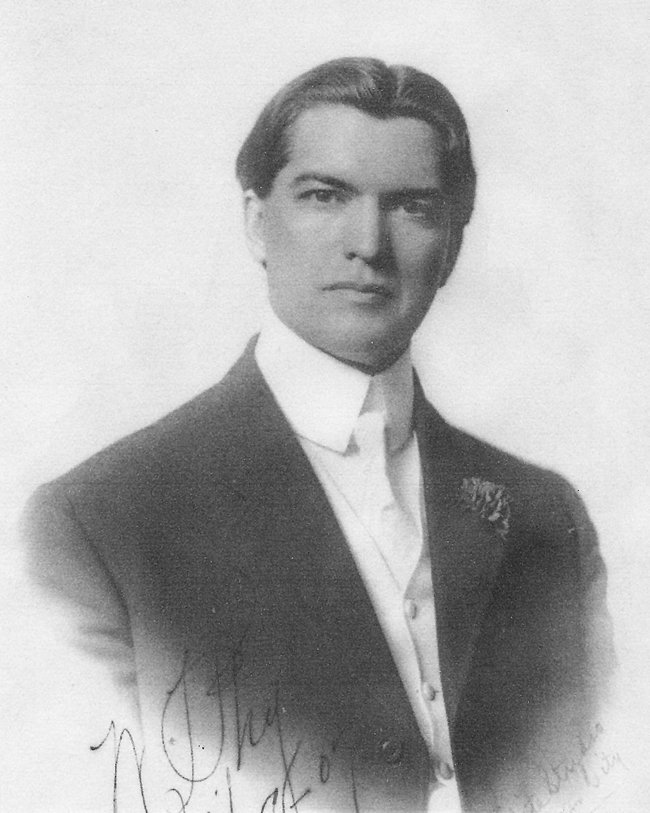
William Thomas Phy had been involved with the project since 1904. In 1917 he bought it outright and renamed it Hot Lake Sanitorium, pushing the property harder toward medicine. With fifteen nurses, four physicians, a radiographer and a bacteriologist on staff, it picked up the nickname The Mayo Clinic of the West. Whether the Mayo brothers themselves ever came is another matter. Historian Dick Roth, whose father later owned the hotel, was flat about it: there is no documentation that he had any social interaction with the Mayo brothers and no documentation that they ever visited.
The treatments were experimental and, in places, plainly wrong. Advertisements promoted drinking the water as relief for heart lesions, nephritis and high blood pressure. Phy attempted to treat syphilis patients with the thermal water, theorizing incorrectly that the sulfur content would kill the infection. He died at Hot Lake in March 1931, of bulbar paralysis, after months of septic arthritis.
The Fire of May 7, 1934
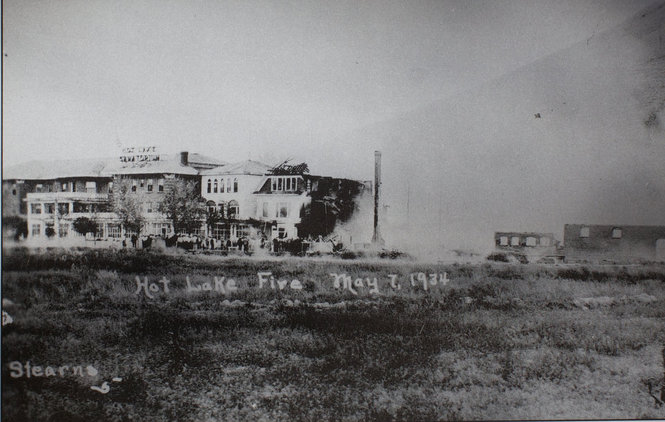
On the morning of May 7, 1934, fire broke out in the west end of the hotel and destroyed the wooden shingle style structure along with the bathhouse. It started in a disused attic space and the cause was never identified. Eleven patients and two infants were present and all escaped unharmed. The 65,000-square-foot brick eastern portion survived; damages were put at $75,000.
Before the fire the building had held nearly 300 rooms and dining space for more than 1,000 guests. Afterward, business fell away until the third-floor hospital was the only part still functioning. A flight school and nurse’s training center operated here from 1939 during World War II.
Nursing Home, Dance Hall, and Twelve Years of Ruin
Bacteriologist Dr. Adolph Roth bought the property in 1942, already in poor condition, and ran it as a resort and health spa for a decade. After U.S. Route 30 and Oregon Route 203 pulled passing traffic away, the Roths converted the building into a nursing home for the elderly and disabled. Dave and Donna Pattee took over in 1974 and ran a restaurant and dance hall in 1976 and 1977. After foreclosure, former Manhattan stockbroker and San Francisco developer Steve Munson bought it, held it eight years, and never got his destination resort off the ground. A bath house occupied one corner from 1985 until it closed.
By 1991 the hotel stood abandoned, open to vandals and weather, and it stayed that way through the decade. When David Manuel purchased it in 2003 from Charles and Louise Rhea, all 368 windows were broken or missing and the roof was barely there. Two years of work later it opened for tours in 2005. The west wing collapsed in 2008 and the family kept going. By 2010 it was running as a bed and breakfast with a spa, restaurant, bronze foundry and museum.
What the Hot Lake Ghost Stories Actually Rest On
Be clear about the evidence here, because it is thinner than the building’s reputation suggests. In 2001, while the hotel sat derelict, it was featured on the ABC Family documentary series The Scariest Places on Earth, which highlighted alleged paranormal activity inside. Susan Smitten’s Ghost Stories of Oregon, also published in 2001, is among the works cited in the hotel’s documented history. That television appearance is the origin point for most of what circulates online today.
The historical record supports a surgical ward, an operating theater on the third floor, a nursing home for the elderly and disabled, a death on site in 1931, and a fire that emptied half the building. It does not, by itself, record specific apparitions, named witnesses or verified events. Visitors who arrive expecting documented hauntings should know that the documentation covers the medicine and the architecture, not the ghosts.
Staying at Hot Lake Springs Resort
Michael Rysavy, who owns the Grande Hot Springs RV Resort next door, took over management in April 2020 and the property was renamed Hot Lake Springs Resort. Renovations since then have added a pub, upgraded rooms, a hot springs soaking area and a 60-seat movie theater, along with substantial work on plumbing, electrical and fire suppression systems. Fifteen renovated suites opened for lodging in 2021, with 24-hour access to the pools for guests, and there are plans for as many as 25 more pools.
This is a working hotel rather than a ruin, so the visit on offer is a booked room, a soak, and a building whose scale still reads as a small self-contained town. Anyone chasing the 2001 version of Hot Lake, roofless and smashed, is about twenty years too late.
Address: Hot Lake, Union County, Oregon
See Hot Lake Hotel for Yourself
Sources
- One Of The West's Most Historic Hot Springs Lodges Is An Oregon Gem With An Eerie Once-Abandoned History
- National Register of Historic Places Inventory, Nomination Form: Hot Lake Resort (National Park Service)
- John Bennes and OSU's Architectural Legacy, 1907-1941 (Oregonstate (official site))
- Oregon National Register List
- Hot Lake Springs…The Arkansas of Oregon?
- Wikipedia: Hot Lake Hotel
Frequently Asked Questions
Where is Hot Lake Hotel Sanatorium Oregon located?
Hot Lake Hotel Sanatorium Oregon is located at Hot Lake, Union County, Oregon.
Can you visit Hot Lake Hotel Sanatorium Oregon?
Hot Lake Hotel Sanatorium Oregon is a place where you can stay overnight. Always follow posted rules and respect private property.
Reader sightings
Nobody has reported anything here yet. If you have been, you would be the first.
Report your own visit to The Mayo Clinic of the West: Haunted Hot Lake Hotel
How haunted is this place?
Be the first to rate
Leave a Reply